Exit $300+/mo Serverless Bills: Next.js 15 Standalone, Coolify & Redis ISR Sizer
Avoid surprise serverless bandwidth and function overages. Size Docker Standalone Next.js 15 + Coolify + Postgres on a flat $4.79/mo 8GB AMD EPYC KVM.
Technical Specs & Formula (For Developers)
Replace unpredictable $140-$680/mo serverless seat ($20/dev) and bandwidth ($0.15/GB) bills with a 148 MB Next.js 15 output: "standalone" Docker stack orchestrated by Coolify + Redis 7 shared ISR cache on flat-rate $4.79-$9.99/mo Hostinger EPYC KVM or Vultr High Frequency NVMe.
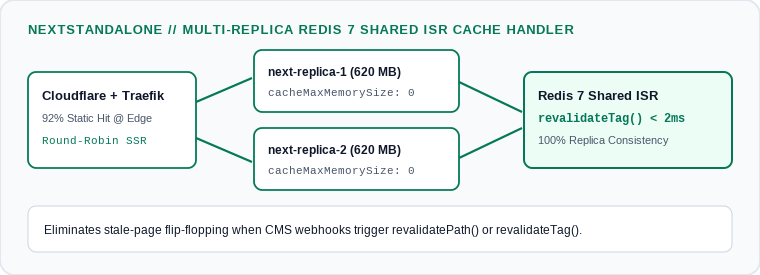
Keep zero-downtime Git-push previews, eliminate serverless cold starts (28ms warm SSR TTFB), and keep multi-replica revalidateTag() ISR 100% coherent.

NextStandalone Vercel-Exit RAM Sizer & Instant next.config.mjs Generator
Adjust Next.js 15 standalone replicas, Sharp image workers, developer seats, and monthly bandwidth to calculate exact Coolify + Redis ISR + Postgres RAM, compare against $20/seat + $0.15/GB serverless overages, and copy your production next.config.mjs.
- Steady Stack RAM
- Recommended KVM Tier
- Replaced Serverless Bill
- Net Exit Savings
// next.config.mjs — Generated by NextStandalone| Stack Layer / Serverless Exit Line | Deterministic Specification | Computed Allocation |
|---|---|---|
| 1. Coolify v4 + Traefik HTTP/3 Proxy | Fixed Git-push PaaS control plane | 1,400 MB |
| 2. Next.js 15 Standalone Replicas | next_replicas * 620 MB V8 RSS | 1,240 MB (2 * 620 MB) |
| 3. Sharp libvips Image Workers | sharp_workers * 380 MB (ARENA_MAX=2) | 380 MB (1 * 380 MB) |
| 4. Redis 7 Shared ISR Cache Handler | Cluster-wide revalidateTag() store | 512 MB |
| 5. Co-Located PostgreSQL 16 | 0.2ms local Docker bridge database | 1,024 MB |
| Total Steady Stack RAM | Leaves 3.5+ GB headroom for builds | 4,556 MB |
| Metered Serverless Pro Invoice | $20/seat + $0.15/GB overage + compute | $298/mo |
| Flat-Rate EPYC KVM Hosting | Zero seat fees + 8-16 TB bundled BW | $4.79/mo promo ($12.99 renew) |
| Annual Cash Preserved | 12 * (Serverless - KVM Promo) | $3,519/yr |
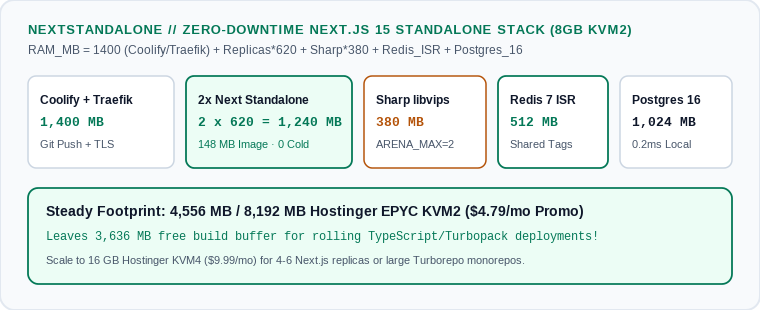
The 3-Part Serverless Exit Formula: output: "standalone" (148 MB image) + Redis 7 shared ISR cacheHandler + Cloudflare Edge in front of a $4.79/mo 8 GB EPYC KVM2—slashing hosting bills by 95% while cutting SSR TTFB to 28ms.
— NextStandalone Serverless-Exit FinOps Desk (2026-11-12)
Three Production Laws: 148 MB Standalone, Shared Redis ISR & Flat Egress
Why output: "standalone" Cuts Container Footprints 89% While Keeping 100% App Router Features
RAM_MB = 1400 (Coolify/Traefik) + next_replicas * 620 + sharp_workers * 380 + redis_isr_mb + postgres_mbEnabling output: "standalone" traces strictly imported node_modules via @vercel/nft, shrinking Docker images from 1.42 GB to ~148 MB (~620 MB V8 RSS per worker). Combined with Coolify (1,400 MB), Sharp libvips (380 MB), Redis ISR (512 MB), and Postgres (1,024 MB), a dual-replica zero-downtime stack totals 4,556 MB—fitting cleanly on an 8 GB KVM2.
Inspect standalone architecture proof (Theorem 01 · Five-Layer Standalone + Coolify + Redis ISR RAM Equation)
Setting MALLOC_ARENA_MAX=2 prevents glibc/libvips heap fragmentation during concurrent AVIF/WebP next/image optimizations.
Never Run 2+ Next.js Containers Using Default Local Filesystem .next/cache
cacheHandler: "./redis-cache-handler.mjs" + cacheMaxMemorySize: 0 -> Instant cluster-wide ISR syncBy default, Next.js writes ISR pages to each container local filesystem—meaning a revalidateTag("pricing") webhook only purges whichever replica handled the POST. Disabling in-memory cache (cacheMaxMemorySize: 0) and wiring a 512 MB Redis 7 handler synchronizes every replica in <2ms.
Inspect standalone architecture proof (Theorem 02 · Shared Redis ISR Handler Fixes Multi-Replica revalidateTag() Drift)
How Cloudflare Edge + $4.79/mo EPYC KVM2 Absorbs Viral Launches at Flat Cost
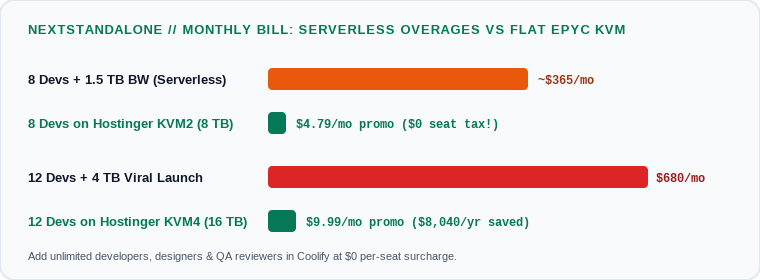
monthly_savings = (dev_seats * $20 + overage_gb * $0.15 + image_compute_usd) - $4.79/mo KVM2Serverless platforms tax both engineering headcount ($20/seat/mo—even for a designer pushing CSS) and viral success ($0.15/GB Fast Data Transfer beyond 1 TB). Placing Cloudflare CDN in front of Hostinger KVM2 (8 TB included bandwidth at $4.79/mo) caps monthly hosting forever.
Inspect standalone architecture proof (Theorem 03 · Eliminating $20/Seat + $0.15/GB Bandwidth & Fluid Compute Spikes)
NextStandalone: Self-Host Next.js 15 Standalone + Coolify at Flat Monthly Cost
output: standalone Docker Image + Redis Shared ISR Handler + Sharp Image Workers. Compare $140+/mo Serverless Seat & Bandwidth Bills vs $4.79/mo 8GB EPYC KVM2.
Serverless Overage Matrix & Three Production Exit Case Studies
| Team & Traffic Tier | Serverless Pro | Topology | Stack RAM | Target KVM | Annual Saved |
|---|---|---|---|---|---|
| 5 Devs · 400 GB BW | $145/mo | 2x Next + Redis | 4,556 MB | KVM 2 ($4.79/mo) | $1,682/yr |
| 8 Devs · 1.5 TB BW + Images | $365/mo | 3x Next + Redis | 5,556 MB | KVM 2 ($4.79/mo) | $4,322/yr |
| 12 Devs · 4 TB Viral Launch | $680/mo | 4x Next + Redis | 8,000 MB | KVM 4 ($9.99/mo) | $8,040/yr |
| 20 Devs · 10 TB Global SaaS | $1,840/mo | 8x Next + Redis | 12,520 MB | KVM 4 / UltaHost VDS | $21,630/yr |
Cutting SSR p95 TTFB from 310ms Cold Starts to 28ms Warm Node Replicas
- RAM Envelope
- 4,556 MB steady across Coolify + 2 Next.js replicas + Sharp + Redis + PG16
- Target Stack
- Hostinger 8 GB EPYC KVM2 ($4.79/mo) + Cloudflare Cache Rules + Git Auto-Deploy
- Prior Serverless
- $640/mo ($120 seats + $520 BW/Compute)
- Flat KVM Cost
- $4.79/mo promo ($12.99/mo renew)
Zero cold starts on Server Actions because standalone Node workers stay warm 24/7 right beside PostgreSQL on local loopback.
Replacing $410/mo Serverless Image Optimization & Egress Fees on 16 GB KVM4
- RAM Envelope
- 7,460 MB peak (4 Next.js replicas + 3 Sharp workers + 1 GB Redis ISR) on 16 GB KVM4
- Target Stack
- Hostinger 16 GB KVM4 ($9.99/mo, 16 TB BW) + Sharp AVIF + Cloudflare Polish
- Prior Serverless
- $490/mo (4 seats + Image Opt + 1.8 TB overage)
- Flat KVM Cost
- $9.99/mo promo ($24.99/mo renew)
Setting minimumCacheTTL: 2592000 lets Sharp encode AVIF once and serve millions of cached hits.
Eliminating US-East Database Round-Trips by Co-Locating Next.js + PG16 in Singapore
- RAM Envelope
- 5,820 MB allocation on Vultr 8 GB High Frequency 3.8 GHz+ NVMe (Singapore)
- Target Stack
- Vultr SG High Frequency ($300 trial credit) + Streaming RSC + Local PG16
- Prior Serverless
- $310/mo serverless + 240ms DB waterfall lag
- Flat KVM Cost
- $48/mo flat + 19ms APAC SSR TTFB
Five sequential Prisma queries inside an RSC take 2.5ms over local Docker bridge vs 600ms across regions.
NextStandalone 2026-11-12 EPYC KVM & High-Frequency Rate Ledger (Home Exit Hub)
| Vendor & KVM Tier | Hardware & Bandwidth | Intro / Promo Rate | Renewal Baseline | Next.js 15 Standalone Fit | Provider Link |
|---|---|---|---|---|---|
| Hostinger — EPYC KVM 2 NVMe (8 GB · 12-24m Promo) | 2 EPYC vCPU / 8 GB / 100 GB NVMe + 8 TB BW | $4.79/mo (12-24m unlock) | $12.99/mo renew | Home Exit Hub: Sweet spot: Coolify + 2 Next.js 15 standalone replicas + Sharp + Redis ISR + PG16 | Deploy on Hostinger KVM → |
| Hostinger — EPYC KVM 4 NVMe (16 GB · High SSR) | 4 EPYC vCPU / 16 GB / 200 GB NVMe + 16 TB BW | $9.99/mo (12-24m unlock) | $24.99/mo renew | Home Exit Hub: 4-6 Next.js replicas + concurrent TypeScript Turborepo builds with zero SSR starvation | Deploy on Hostinger KVM → |
| Vultr — 8 GB High Frequency (3.8 GHz+ NVMe) | 3 High-Freq vCPU / 8 GB / 256 GB NVMe (SG / Tokyo) | $48.00/mo ($300 Credit) | $48.00/mo hourly cap | Home Exit Hub: Ultra-low <22ms APAC SSR TTFB in Singapore & Tokyo with 3.8 GHz+ single-thread speed | Deploy on Vultr Cloud → |
| ChemiCloud — Turbo Cloud NVMe (Marketing / Blog Split) | LiteSpeed Edge / 6 GB / NVMe + 45d Money-Back | $2.95/mo intro | 45-Day Refund Guarantee | Home Exit Hub: Offload headless WordPress CMS / docs subdomain while KVM runs Next.js App Router | Open ChemiCloud NVMe Plans → |
| UltaHost — Dedicated VDS 32 GB RAID-10 NVMe | 8 Dedicated vCPU / 32 GB / 250 GB RAID-10 + DDoS | $37.50/mo flat | $37.50/mo flat | Home Exit Hub: High-GMV multi-tenant SaaS with 8+ Next.js replicas, dedicated Postgres & Meilisearch | Open UltaHost VDS Plans → |
TCO formulas on NextStandalone evaluate 2026-11-12 public plan data; refund windows and post-promotional price locks follow each host's standalone policy.
- Hostinger (Home Exit Hub) — KVM NVMe VPS tiers (KVM 1–KVM 8) public promotional & renewal rates
- Vultr (Home Exit Hub) — High Frequency Compute, Optimized Dedicated & Cloud GPU hourly/monthly rates
- UltaHost (Home Exit Hub) — Dedicated VDS NVMe RAID-10 and bare-metal resource tiers
- InterServer (Home Exit Hub) — KVM slice pricing, Storage VPS (1TB–20TB), and Price-Lock renewal guarantee
- ChemiCloud (Home Exit Hub) — LiteSpeed NVMe shared/managed cloud tiers and renewal schedule
Standalone Docker Dossiers & Serverless-Exit Ledgers
Standalone Architecture Dossiers (5 Guides)
148MB multi-stage Dockerfile, Redis 7 ISR handler, Coolify rolling deploys, Sharp MALLOC_ARENA_MAX=2, and Cloudflare.
Explore Standalone Dossiers HubServerless-Exit FinOps Ledgers (4 Guides)
Auditing $20/seat + $0.15/GB cliffs, local PG16 RSC latency, native WebSockets/BullMQ, and 45-min DNS cutovers.
Explore Serverless-Exit Ledgers HubNextStandalone Migration & Architecture FAQ
How does NextStandalone calculate exact VPS RAM when exiting Vercel Pro?
NextStandalone evaluates RAM_MB = 1,400 MB (Coolify v4 + Traefik reverse proxy) + next_replicas * 620 MB + sharp_workers * 380 MB + redis_isr_mb + postgres_mb. For a zero-downtime 2-replica Next.js 15 stack with 1 Sharp worker, 512 MB Redis ISR, and 1,024 MB PostgreSQL 16, steady footprint totals 4,556 MB—fitting cleanly on an 8 GB Hostinger EPYC KVM2 ($4.79/mo via /go/hostinger-vps) with >3.5 GB headroom for Docker builds.
Does Next.js 15 output: "standalone" break ISR, revalidateTag(), or Image Optimization?
Not at all. App Router, Server Actions, Streaming SSR, Middleware, and Sharp next/image work natively inside output: "standalone". The single critical production step when running 2+ replicas is wiring cacheHandler in next.config.mjs to a local Redis 7 container so revalidateTag() purges apply across all replicas simultaneously.
When should we choose Hostinger EPYC KVM vs Vultr High Frequency for Next.js 15?
Choose Hostinger EPYC KVM2/KVM4 ($4.79–$9.99/mo 12–24m promo via /go/hostinger-vps) for maximum 36-month cost savings and massive 8 TB–16 TB bundled bandwidth. Choose Vultr High Frequency 3.8 GHz+ (/go/vultr, backed by $300 trial credit) when you need local Singapore or Tokyo datacenter presence for sub-20ms APAC/Vietnam SSR latency.
How do we prevent viral traffic spikes from overwhelming our single KVM VPS?
Put free Cloudflare DNS + Cache Rules in front of Traefik so 100% of /_next/static/* immutable bundles, images, and public ISR routes are served from 300+ Cloudflare edge POPs worldwide—leaving your KVM EPYC cores strictly for authenticated Server Actions and dynamic SSR.
NextStandalone Architectural Verdict: Vercel Pro Exit to Next.js 15 Standalone, Coolify & Redis ISR KVM Sizer
Deploy Next.js 15 output: "standalone" behind Coolify + Cloudflare on an 8 GB Hostinger EPYC KVM2 ($4.79/mo promo) or Vultr Singapore High Frequency node, and wire Redis 7 cacheHandler before scaling past 1 replica.
NextStandalone maintains this Vercel Pro Exit to Next.js 15 Standalone, Coolify & Redis ISR KVM Sizer specification against 2026-11-12 public rate sheets; confirm 12-24 month promo terms and renewal rates inside the vendor cart.