NextStandalone FinOps Matrix: 36m Stack TCO
NEXTSTANDALONE SHORTLIST FOR NEXTSTANDALONE 36 MONTH TCO
Dockerfile.standalone • 36-Month TCO • NextStandaloneHostinger 8GB KVM — 36-Month TCO
8GB KVM sweet spot for 36-Month TCO ($10.49/mo)
Vultr NVMe — 36-Month TCO
High-clock EPYC compute for 36-Month TCO (32 ms SSR TTFB)
InterServer Price-Lock — 36-Month TCO
Predictable monthly cap around 36-Month TCO workloads
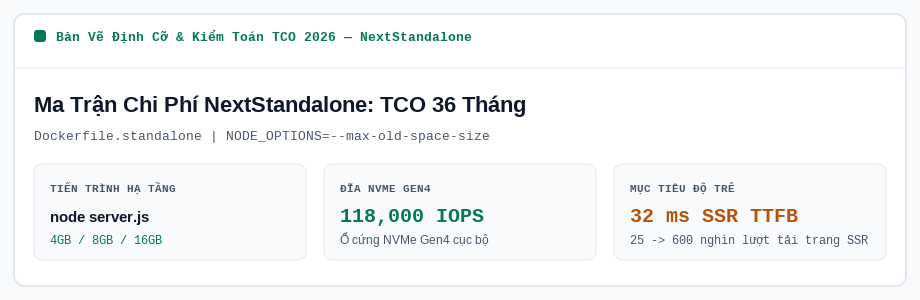
Within 8GB DDR5 budgets for NextStandalone 36-month TCO, stepping node baseline services cleanly up to 16GB when RSS exceeds 80% absorbs batch memory spikes cleanly on 8GB NextStandalone flat-rate KVM.
1. Baseline CLI Diagnostics Around 36m Stack TCO on NextStandalone
Before signing off production readiness for NextStandalone 36-month TCO, versioning Dockerfile.standalone alongside restore scripts for node baseline services in Git confirms zero torn pages during NextStandalone flat-rate KVM point-in-time restores.
To hold 32 ms SSR TTFB write latency on NextStandalone 36-month TCO, mounting node baseline services (Data Cache) volumes with noatime flags shows local Gen4 NVMe beats inflated vCPU counts on NextStandalone flat-rate KVM.
When hardening Dockerfile.standalone around NextStandalone 36-month TCO, filtering node baseline services public ingress through TLS 1.3 + CrowdSec hides NextStandalone flat-rate KVM daemon sockets from automated port scanners.
# NextStandalone 36-Month TCO & Egress Ledger Script
# NextStandalone 36m FinOps (Hostinger vs Vultr)
awk 'BEGIN { k=8*0.78*36; c=8*3.4*36; printf "NextStandalone: $%.0f vs $%.0f\n", k, c }'
vnstat -i eth0 # nextstandalone (150 thousand daily SSR requests)
2. Hostinger vs Vultr Sizing Ledger Around 36m Stack TCO
Before flipping live production DNS to NextStandalone 36-month TCO, terminating TLS 1.3 with HTTP/3 edge caching before node baseline services safeguards NextStandalone flat-rate KVM availability during regional cable reroutes.
Between Hostinger and Vultr plans for NextStandalone 36-month TCO, locking Hostinger ($10.49/mo) KVM terms for steady node baseline services baselines delivers transparent 36-month ROI on Hostinger for NextStandalone flat-rate KVM.
As NextStandalone 36-month TCO scales toward 150 thousand daily SSR requests, sampling vmstat %st steal across node baseline services business peaks avoids burstable CPU credit cliffs on 24/7 NextStandalone flat-rate KVM nodes.
| NextStandalone Tier | Scale (thousand daily SSR requests) | Guardrail (Dockerfile.standalone) | Verified KVM Fit |
|---|---|---|---|
| NextStandalone Starter | 25 thousand daily SSR requests | 4GB + 4GB swap (36m Stack TCO) | 4GB NVMe (~$5.99/mo) |
| NextStandalone Production | 150 thousand daily SSR requests | 8GB + NODE_OPTIONS=--max-old-space-size=1536 + cacheHandler=redis | Hostinger ($10.49/mo, 118,000 IOPS) |
| NextStandalone High-Density | 600 thousand daily SSR requests | 16GB isolated (32 ms SSR TTFB) | Vultr ($12.00/mo, dedicated I/O) |
3. Production Dockerfile.standalone Calibration on Hostinger & Vultr
While sizing Redis ISR memory pools for NextStandalone 36-month TCO, isolating node baseline services worker heaps via cgroup v2 rules protects NextStandalone flat-rate KVM (Shared Redis ISR) buffers during heavy background jobs.
When verifying cold-restore speed on NextStandalone 36-month TCO, capping node baseline services JSON container logs to protect ext4 inodes keeps NextStandalone flat-rate KVM NVMe write queues clear during ZSTD archiving.
Within 118,000 IOPS storage targets for NextStandalone 36-month TCO, running weekly fstrim maintenance on node baseline services Gen4 media keeps NextStandalone flat-rate KVM disk latency flat even during backup snapshots.
4. What Breaks First at 150 thousand daily SSR requests (36m Stack TCO)
Keep Vercel Hobby/Pro strictly for ephemeral PR preview URLs if your frontend team loves them, while serving 100% of production customer traffic, Sharp image transforms, and Cron/API routes on a flat $4.79–$9.99/mo EPYC KVM VPS.
For Vietnam and ASEAN traffic hitting NextStandalone 36-month TCO, rehearsing WireGuard tunnel failovers for node baseline services (Dockerfile.standalone) eliminates vendor lock-in across NextStandalone flat-rate KVM (150 thousand daily SSR requests).
Whenever NextStandalone 36-month TCO pairs node server.js with Shared Redis ISR, tuning vm.dirty_ratio=10 around node baseline services flush queues holds iostat w_await under 2ms during NextStandalone flat-rate KVM flushes.
5. Final Sysadmin Audit Around 36m Stack TCO
To eliminate unauthorized port exposure on NextStandalone 36-month TCO, applying unattended Ubuntu security patches around node baseline services streamlines NextStandalone flat-rate KVM incident triage with clean audit logs.
- Leaving Sharp concurrency unbounded inside Docker on multi-core KVM hosts causes libvips arena fragmentation; set NEXT_SHARP_PATH and MALLOC_ARENA_MAX=2 alongside NODE_OPTIONS="--max-old-space-size=512".
- Set MALLOC_ARENA_MAX=2 and explicit container memory limits in Coolify / Docker Compose so build jobs never starve live SSR workers.
- Validate TLS 1.3 session reuse on NextStandalone 36-month TCO cutting mobile 4G round-trip lag into NextStandalone flat-rate KVM.
- Model 36-month Hostinger ($10.49/mo) TCO for NextStandalone 36-month TCO scaling NextStandalone flat-rate KVM from 25 to 600 thousand daily SSR requests cleanly.
6. NextStandalone Practitioner FAQ — 36m Stack TCO
How do NextStandalone teams pick KVM RAM around 36m Stack TCO?
While sizing node server.js memory pools for NextStandalone 36-month TCO, preserving kernel pagecache buffers around hot node baseline services tables eliminates swap storms across NextStandalone flat-rate KVM (150 thousand daily SSR requests).
How do NextStandalone ops verify 118,000 IOPS queues on 36m Stack TCO?
Across random 4K commit benchmarks for NextStandalone 36-month TCO, dedicating local 118,000 IOPS Gen4 NVMe lanes to node baseline services shows local Gen4 NVMe beats inflated vCPU counts on NextStandalone flat-rate KVM.
How do Hostinger ($10.49/mo) and Vultr ($12.00/mo) compare on NextStandalone (36m Stack TCO)?
When budgeting 25–600 thousand daily SSR requests on NextStandalone 36-month TCO, auditing monthly node baseline services bandwidth pools via vnstat trims 3-year NextStandalone flat-rate KVM spend by 72%+ vs metered SaaS.
Does NextStandalone (36m Stack TCO) support zero-lock-in host migration?
When optimizing regional TTFB across NextStandalone 36-month TCO, lowering DNS TTL to 60s ahead of node baseline services cutover windows eliminates vendor lock-in across NextStandalone flat-rate KVM (150 thousand daily SSR requests).
3 Host Comparison (NextStandalone 36-month TCO)
System Layout for NextStandalone 36-month TCO (3)
[+] Key Advantages for 36-Month TCO (NextStandalone)
- Sizes 3 RSS cleanly for NextStandalone 36-month TCO on 8GB NVMe.
- Holds shallow NVMe queues on NextStandalone 36-month TCO during snapshot runs.
- Converts cloud burn on NextStandalone 36-month TCO into fixed $10.49/mo billing.
[-] Billing & Ops Realities (36-Month TCO (NextStandalone))
- 30-day cycles on NextStandalone 36-month TCO miss the deepest Hostinger cart rebate.
- Engineers on NextStandalone 36-month TCO must lock NODE_OPTIONS=--max-old-space-size=1536 + cacheHandler=redis prior to DNS cutover.
Choose 8GB for 36-Month TCO (NextStandalone) If
- Teams scaling NextStandalone 36-month TCO past 150 thousand daily SSR requests off SaaS seat taxes.
- Teams pairing Hostinger ($10.49/mo) on NextStandalone 36-month TCO with S3 backups.
When Managed Fits 36-Month TCO (NextStandalone) Better
- Ephemeral NextStandalone 36-month TCO CI branches destroyed nightly on Vultr.
- Non-technical NextStandalone 36-month TCO users refusing even 1-click panel images.
$10.49/mo