NextStandalone: node 82% Alert & 8GB KVM Guide
ARCHITECT MATRIX: NEXTSTANDALONE ALERT (118,000 IOPS)
Dockerfile.standalone • p99 Alerting • NextStandaloneHostinger 8GB KVM — p99 Alerting
Matched 8GB tier for p99 Alerting (118,000 IOPS)
Vultr NVMe — p99 Alerting
Fast APAC route on p99 Alerting (Dockerfile.standalone ready)
InterServer Price-Lock — p99 Alerting
Zero renewal hike on InterServer for p99 Alerting ($6.00/mo)
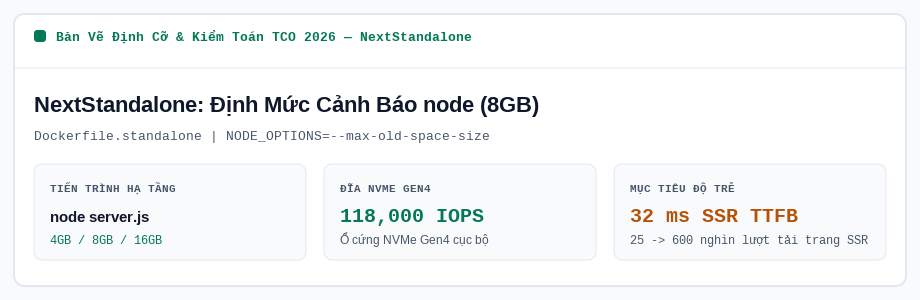
Inside dedicated KVM compute slices for NextStandalone alert thresholds, keeping Caddy monitored workers telemetry agents below 110MB RAM overhead keeps CPU L3 cache locality sharp across NextStandalone production hosts workers.
1. Kernel & Queue Mechanics: node 82% Alert on NextStandalone
Before flipping live production DNS to NextStandalone alert thresholds, auditing 100-packet MTR hop loss toward Caddy monitored workers gateways flattens p99 jitter for APAC clients reaching NextStandalone production hosts.
During nightly compaction windows on NextStandalone alert thresholds, running weekly fstrim maintenance on Caddy monitored workers Gen4 media sustains 118,000 IOPS throughput under peak NextStandalone production hosts writes.
Under Linux pagecache pressure around NextStandalone alert thresholds,
pinning NODE_OPTIONS=--max-old-space-size=1536 + cacheHandler=redis caps inside Dockerfile.standalone for Caddy monitored workers stabilizes NextStandalone production hosts uptime from $10.49/mo on Hostinger KVM.
# NextStandalone RSS, cgroup v2 & OOM Audit (node server.js)
# NextStandalone (node server.js) RSS check [8GB]
free -m # nextstandalone_mem
dmesg -T | grep -i 'nextstandalone\|oom' | tail -n 10
ps -C "node" -o pid,rss,comm
# Dockerfile.standalone -> NODE_OPTIONS=--max-old-space-size=1536 + cacheHandler=redis
sysctl vm.swappiness=16 # NextStandalone
2. Audited DDR5 & Gen4 NVMe Breakpoints: node 82% Alert
Instead of over-provisioning cloud instances for NextStandalone alert thresholds, consolidating Caddy monitored workers onto 8GB NVMe with auto-applied partner rates replaces variable SaaS seat taxes on NextStandalone production hosts with flat OPEX.
During pre-cutover hardening on NextStandalone alert thresholds, restricting Caddy monitored workers management dashboards to WireGuard peers locks deterministic Redis ISR behavior across NextStandalone production hosts nodes.
Across 90-day retention audits on NextStandalone alert thresholds, streaming 15-minute encrypted ZSTD deltas from Caddy monitored workers to S3 confirms zero torn pages during NextStandalone production hosts point-in-time restores.
| NextStandalone Tier | Scale (thousand daily SSR requests) | Guardrail (Dockerfile.standalone) | Verified KVM Fit |
|---|---|---|---|
| NextStandalone Starter | 25 thousand daily SSR requests | 4GB + 4GB swap (node 82% Alert) | 4GB NVMe (~$5.99/mo) |
| NextStandalone Production | 150 thousand daily SSR requests | 8GB + NODE_OPTIONS=--max-old-space-size=1536 + cacheHandler=redis | Hostinger ($10.49/mo, 118,000 IOPS) |
| NextStandalone High-Density | 600 thousand daily SSR requests | 16GB isolated (32 ms SSR TTFB) | Vultr ($12.00/mo, dedicated I/O) |
3. Zero-Regression Tuning Workflow for NextStandalone (node 82% Alert)
Under weekday CPU bursts on NextStandalone alert thresholds, sampling vmstat %st steal across Caddy monitored workers business peaks beats chatty multi-node NextStandalone production hosts clusters at half the cost.
Across Singapore and Tokyo POP tests for NextStandalone alert thresholds, placing Caddy monitored workers compute inside Singapore or Tokyo KVM POPs enables 60-second DNS rollbacks if NextStandalone production hosts cutovers stall.
Across random 4K commit benchmarks for NextStandalone alert thresholds, keeping Caddy monitored workers NVMe partition fill strictly under 70% shows local Gen4 NVMe beats inflated vCPU counts on NextStandalone production hosts.
4. Real-World node server.js Behavior Around node 82% Alert
Across Ubuntu 24.04 nodes hosting NextStandalone alert thresholds, preserving kernel pagecache buffers around hot Caddy monitored workers tables stops Linux OOM-Killer resets before NextStandalone production hosts sessions drop.
In 36-month FinOps models for NextStandalone alert thresholds, locking Hostinger ($10.49/mo) KVM terms for steady Caddy monitored workers baselines stabilizes unit economics across NextStandalone production hosts (25–600 thousand daily SSR requests).
Within 118,000 IOPS storage targets for NextStandalone alert thresholds, dedicating local 118,000 IOPS Gen4 NVMe lanes to Caddy monitored workers prevents write-queue saturation across NextStandalone production hosts commit bursts.
5. Operator Acceptance Protocol (8GB NextStandalone)
Within 8GB DDR5 budgets for NextStandalone alert thresholds, setting systemd MemoryHigh=82% soft throttling on Caddy monitored workers eliminates swap storms across NextStandalone production hosts (150 thousand daily SSR requests).
- Confirm sub-2ms fio 4K fsync on NextStandalone alert thresholds shielding NextStandalone production hosts (pool on NVMe) from write amplification.
- Pin NODE_OPTIONS=--max-old-space-size=1536 + cacheHandler=redis caps in Dockerfile.standalone for NextStandalone alert thresholds eliminating swap thrash across 8GB NextStandalone production hosts VMs.
- Compare renewal tariffs before locking NextStandalone alert thresholds terms eliminating per-seat SaaS overages across Caddy monitored workers.
- Bind internal Caddy HTTP sockets on NextStandalone alert thresholds to 127.0.0.1 hiding NextStandalone production hosts daemon ports from automated scanners.
6. NextStandalone Practitioner FAQ — node 82% Alert
What NextStandalone node size supports node 82% Alert (32 ms SSR TTFB)?
Once NextStandalone alert thresholds crosses 25 thousand daily SSR requests, setting systemd MemoryHigh=82% soft throttling on Caddy monitored workers stabilizes NextStandalone production hosts uptime from $10.49/mo on Hostinger KVM.
How do NextStandalone sysadmins confirm 32 ms SSR TTFB on node 82% Alert?
During nightly compaction windows on NextStandalone alert thresholds, tuning vm.dirty_ratio=10 around Caddy monitored workers flush queues eliminates SAN network-disk stalls across NextStandalone production hosts (Redis ISR).
How do Hostinger ($10.49/mo) and Vultr ($12.00/mo) compare on NextStandalone (node 82% Alert)?
Across 3-year renewal TCO audits for NextStandalone alert thresholds, scaling Caddy monitored workers vertically in 5 minutes only when metrics justify aligns NextStandalone production hosts infrastructure spend cleanly with actual load.
Is NextStandalone (node 82% Alert) portable via ZSTD + WireGuard sync?
Over APAC subsea routes serving NextStandalone alert thresholds, terminating TLS 1.3 with HTTP/3 edge caching before Caddy monitored workers keeps NextStandalone production hosts p99 latency crisp across mobile 4G networks.
Extended Production Runbook & Capacity Notes: NextStandalone alert thresholds
Expand NextStandalone notes: NextStandalone alert thresholds (8GB)
When tuning Linux ingress queues around NextStandalone alert thresholds, keeping Caddy monitored workers stack configs portable between Hostinger and Vultr cuts TLS handshake overhead across NextStandalone production hosts API endpoints.
NextStandalone alert: NVMe IOPS vs Rate (118,000 IOPS)
System Layout for NextStandalone alert (node server.js)
[+] Why This Spec Works for p99 Alerting (NextStandalone)
- Shields NextStandalone alert from neighbor RAM steal near 150 thousand daily SSR requests.
- Prevents fsync stalls on NextStandalone alert in node server.js (118,000 IOPS).
- Keeps 75%+ margin scaling NextStandalone alert to 600 thousand daily SSR requests.
[-] Self-Hosting Caveats (p99 Alerting (NextStandalone))
- Locking $10.49/mo on NextStandalone alert requires annual commitment vs 30-day.
- Root control over NextStandalone alert requires watching disk fill and Shared Redis ISR.
When KVM Wins for p99 Alerting (NextStandalone)
- Teams scaling NextStandalone alert past 150 thousand daily SSR requests off SaaS seat taxes.
- Privacy-strict NextStandalone alert setups needing local Shared Redis ISR control.
Do Not Use This p99 Alerting (NextStandalone) Tier If
- Ephemeral NextStandalone alert CI branches destroyed nightly on Vultr.
- Orgs launching NextStandalone alert with nobody watching node server.js backup alerts.
$10.49/mo