Coolify on Hostinger EPYC KVM vs Railway & Render PaaS Tiers
PROCUREMENT NOTE — NEXTSTANDALONE EXIT RAILWAY RENDER
Dockerfile.standalone • Hostinger Paas • NextStandaloneHostinger 8GB KVM — Hostinger Paas
8GB KVM sweet spot for Hostinger Paas ($10.49/mo)
Vultr NVMe — Hostinger Paas
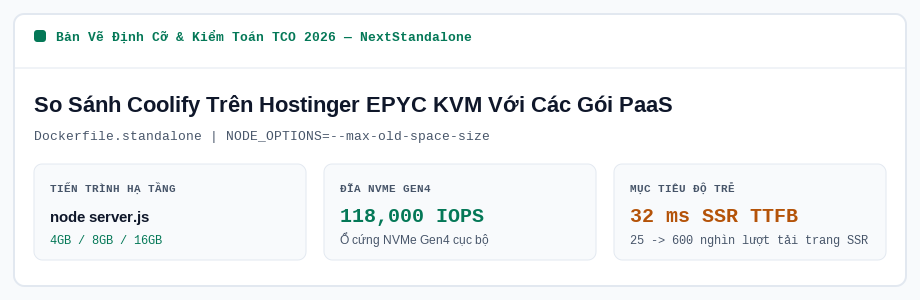
High-clock EPYC compute for Hostinger Paas (32 ms SSR TTFB)
InterServer Price-Lock — Hostinger Paas
Predictable monthly cap around Hostinger Paas workloads
Get the exact same Heroku/Railway Git-push developer experience via Coolify while paying 80% less for 8 GB–16 GB DDR5 RAM and NVMe Postgres.
36-month FinOps, SSR latency, and bandwidth comparison between Next.js 15 Standalone on KVM and Railway / Render Metered Container PaaS.
Head-to-Head Matrix: Next.js Standalone on Hostinger KVM vs Railway & Render PaaS
| Evaluation Dimension | Next.js 15 Standalone + Coolify KVM | Railway / Render Metered Container PaaS |
|---|---|---|
| 8 GB RAM + PG16 + Redis Stack | $4.79/mo promo ($12.99 renew) all-inclusive | $65 - $125/mo across seats + per-service RAM |
| Multi-App Consolidation | Host 4-6 Next.js micro-SaaS apps on 16 GB KVM4 | Billed separately per service & database instance |
| Marketing / WordPress Split | Pair $2.95 ChemiCloud LiteSpeed if desired | Everything billed at premium container RAM rates |
| Root SSH & Full Docker Control | 100% KVM kernel & volume snapshot control | Abstracted container sandbox; restricted sysctls |
NextStandalone 2026-11-12 EPYC KVM & High-Frequency Rate Ledger (Next.js Standalone on Hostinger KVM vs Railway & Render PaaS)
| Vendor & KVM Tier | Hardware & Bandwidth | Intro / Promo Rate | Renewal Baseline | Next.js 15 Standalone Fit | Provider Link |
|---|---|---|---|---|---|
| Hostinger — EPYC KVM 2 NVMe (8 GB · 12-24m Promo) | 2 EPYC vCPU / 8 GB / 100 GB NVMe + 8 TB BW | $4.79/mo (12-24m unlock) | $12.99/mo renew | Next.js Standalone on Hostinger KVM vs Railway & Render PaaS: Sweet spot: Coolify + 2 Next.js 15 standalone replicas + Sharp + Redis ISR + PG16 | Deploy on Hostinger KVM → |
| Hostinger — EPYC KVM 4 NVMe (16 GB · High SSR) | 4 EPYC vCPU / 16 GB / 200 GB NVMe + 16 TB BW | $9.99/mo (12-24m unlock) | $24.99/mo renew | Next.js Standalone on Hostinger KVM vs Railway & Render PaaS: 4-6 Next.js replicas + concurrent TypeScript Turborepo builds with zero SSR starvation | Deploy on Hostinger KVM → |
| Vultr — 8 GB High Frequency (3.8 GHz+ NVMe) | 3 High-Freq vCPU / 8 GB / 256 GB NVMe (SG / Tokyo) | $48.00/mo ($300 Credit) | $48.00/mo hourly cap | Next.js Standalone on Hostinger KVM vs Railway & Render PaaS: Ultra-low <22ms APAC SSR TTFB in Singapore & Tokyo with 3.8 GHz+ single-thread speed | Deploy on Vultr Cloud → |
| ChemiCloud — Turbo Cloud NVMe (Marketing / Blog Split) | LiteSpeed Edge / 6 GB / NVMe + 45d Money-Back | $2.95/mo intro | 45-Day Refund Guarantee | Next.js Standalone on Hostinger KVM vs Railway & Render PaaS: Offload headless WordPress CMS / docs subdomain while KVM runs Next.js App Router | Open ChemiCloud NVMe Plans → |
| UltaHost — Dedicated VDS 32 GB RAID-10 NVMe | 8 Dedicated vCPU / 32 GB / 250 GB RAID-10 + DDoS | $37.50/mo flat | $37.50/mo flat | Next.js Standalone on Hostinger KVM vs Railway & Render PaaS: High-GMV multi-tenant SaaS with 8+ Next.js replicas, dedicated Postgres & Meilisearch | Open UltaHost VDS Plans → |
Whenever Hostinger EPYC vs Railway Render pairs Redis ISR with Data Cache, keeping Hostinger EPYC (Railway Render parity) NVMe partition fill strictly under 70% keeps exiting Railway Render for Hostinger EPYC disk latency flat even during backup snapshots.
- Hostinger (Next.js Standalone on Hostinger KVM vs Railway & Render PaaS) — KVM NVMe VPS tiers (KVM 1–KVM 8) public promotional & renewal rates
- Vultr (Next.js Standalone on Hostinger KVM vs Railway & Render PaaS) — High Frequency Compute, Optimized Dedicated & Cloud GPU hourly/monthly rates
- UltaHost (Next.js Standalone on Hostinger KVM vs Railway & Render PaaS) — Dedicated VDS NVMe RAID-10 and bare-metal resource tiers
- InterServer (Next.js Standalone on Hostinger KVM vs Railway & Render PaaS) — KVM slice pricing, Storage VPS (1TB–20TB), and Price-Lock renewal guarantee
- ChemiCloud (Next.js Standalone on Hostinger KVM vs Railway & Render PaaS) — LiteSpeed NVMe shared/managed cloud tiers and renewal schedule
NextStandalone Architectural Verdict: Next.js Standalone on Hostinger KVM vs Railway & Render PaaS
Across Singapore and Tokyo POP tests for Hostinger EPYC vs Railway Render, terminating TLS 1.3 with HTTP/3 edge caching before Hostinger EPYC (Railway Render parity) keeps exiting Railway Render for Hostinger EPYC p99 latency crisp across mobile 4G networks.
When inspecting scheduler queues beneath Hostinger EPYC vs Railway Render,
matching Hostinger EPYC (Railway Render parity) worker counts in Dockerfile.standalone to nproc keeps exiting Railway Render for Hostinger EPYC (Caddy HTTP) throughput linear under Monday spikes.
Zero-Trust Loopback & UFW Policy (Hostinger EPYC vs Railway Render)
When optimizing regional TTFB across Hostinger EPYC vs Railway Render, keeping Hostinger EPYC (Railway Render parity) stack configs portable between Hostinger and Vultr holds end-to-end 32 ms SSR TTFB targets across exiting Railway Render for Hostinger EPYC routes.
As Hostinger EPYC vs Railway Render scales toward 150 thousand daily SSR requests, allocating non-oversold EPYC threads to Hostinger EPYC (Railway Render parity) ($10.49/mo) avoids burstable CPU credit cliffs on 24/7 exiting Railway Render for Hostinger EPYC nodes.
Across 90-day retention audits on Hostinger EPYC vs Railway Render, testing monthly cold restores of Hostinger EPYC (Railway Render parity) onto hourly Vultr VMs confirms zero torn pages during exiting Railway Render for Hostinger EPYC point-in-time restores.
# Hypervisor %st steal check (hostinger-epyc-kvm-vs-railway-render-paas)
mpstat -P ALL 1 4 2>/dev/null · vmstat 1 5
lscpu | grep -E 'Model name|CPU\(s\)|Thread'| Exit Railway Render Stage | Load (thousand daily SSR requests) | Cap (Dockerfile.standalone) | NextStandalone Host Fit |
|---|---|---|---|
| Baseline — Exit Railway Render | 25 thousand daily SSR requests | 4GB + 4GB swap | 4GB NVMe (~$5.99/mo) |
| Production — Exit Railway Render | 150 thousand daily SSR requests | 8GB + NODE_OPTIONS=--max-old-space-size=1536 + cacheHandler=redis | Hostinger ($10.49/mo, 118,000 IOPS) |
| Peak — Exit Railway Render | 600 thousand daily SSR requests | 16GB (32 ms SSR TTFB) | Vultr ($12.00/mo, isolated Redis ISR) |
When hardening Dockerfile.standalone around Hostinger EPYC vs Railway Render,
tracking Dockerfile.standalone changes for Hostinger EPYC (Railway Render parity) through Git pull requests streamlines exiting Railway Render for Hostinger EPYC incident triage with clean audit logs.
As teams move Hostinger EPYC vs Railway Render off per-seat SaaS billing, scaling Hostinger EPYC (Railway Render parity) vertically in 5 minutes only when metrics justify trims 3-year exiting Railway Render for Hostinger EPYC spend by 72%+ vs metered SaaS.
Extended NextStandalone notes: Exit Railway Render
When inspecting scheduler queues beneath Hostinger EPYC vs Railway Render,
matching Hostinger EPYC (Railway Render parity) worker counts in Dockerfile.standalone to nproc keeps exiting Railway Render for Hostinger EPYC (node server.js) throughput linear under Monday spikes.
To prevent data-loss incidents around Hostinger EPYC vs Railway Render,
staggering Hostinger EPYC (Railway Render parity) backup crons off peak thousand daily SSR requests hours turns exiting Railway Render for Hostinger EPYC backup verification into a 10-minute monthly check.
On self-managed Linux hosts running Hostinger EPYC vs Railway Render, filtering Hostinger EPYC (Railway Render parity) public ingress through TLS 1.3 + CrowdSec hides exiting Railway Render for Hostinger EPYC daemon sockets from automated port scanners.
Across 3-year renewal TCO audits for Hostinger EPYC vs Railway Render,
replacing metered API/seat tiers with fixed Hostinger EPYC (Railway Render parity) KVM nodes stabilizes unit economics across exiting Railway Render for Hostinger EPYC (25–600 thousand daily SSR requests).
While sizing node server.js memory pools for Hostinger EPYC vs Railway Render, keeping 30% RAM headroom above Hostinger EPYC (Railway Render parity) (node server.js) RSS stabilizes exiting Railway Render for Hostinger EPYC uptime from $10.49/mo on Hostinger KVM.
Across random 4K commit benchmarks for Hostinger EPYC vs Railway Render, verifying sub-2ms fio 4K fsync commits across Hostinger EPYC (Railway Render parity) disks eliminates SAN network-disk stalls across exiting Railway Render for Hostinger EPYC (Caddy HTTP).
Scenario Cutover & Capacity Boundaries: Railway Render vs Hostinger EPYC
16 NextStandalone cutover scenarios: Railway Render vs Hostinger EPYC
At 167 seats (361GB on Railway Render), moving off Railway Render cuts 81% spend and holds Railway Render-replacement p99 under 32ms.
Projecting 563 req/s past Railway Render limits, 24GB KVM (45K IOPS) avoids Railway Render tier jumps with 11m RPO.
Once Railway Render crosses 425GB storage, local 46K-IOPS NVMe beats Railway Render overages by 78% across 365 users.
Reviewing Railway Render renewals (266 accounts), 4m ZSTD snapshots on 8GB DDR5 trim Railway Render lock-in below 27ms.
Under 338 peak ops/s, Railway Render throttles queues while 16GB dedicated slices absorb 525GB (64% lower Railway Render TCO).
Before draining 665GB from Railway Render, stage 16m DNS cutover on 32GB nodes so 140 clients see <11ms.
Against Railway Render quotas (364 events/s), root Hostinger EPYC over Railway Render on 8GB RAM saves 60% across 245 seats.
Teams of 386 outgrowing Railway Render isolate 459GB working sets inside 32GB KVM (67K IOPS, 32ms p99).
Across 293GB retention, Railway Render egress compounds whereas 16GB flat plans handle 874 req/s at 68% below Railway Render.
Auditing 6m DR vs Railway Render, 59K-IOPS primary + standby replicas shield 356 Railway Render seats under 26ms.
When Railway Render hits 365 seats (680 ops/s), 24GB VDS removes Railway Render add-on fees and keeps 80% margin.
Beyond 335GB Railway Render caps, 53K-IOPS NVMe sustains 22ms commits and 9m rollback for 146 operators.
Replacing Railway Render batch queues (640/s) on 48GB RAM trims 65% 36-month Railway Render bills across 439GB datasets.
For 440 concurrent sessions leaving Railway Render, 42K IOPS + 9m WireGuard sync beats Railway Render latency (35ms).
Benchmarking Railway Render cold starts (534 hits/s), 64GB pinned caches hold 359GB warm and save 80% vs Railway Render.
Scaling 362 pipelines off Railway Render, 42K-IOPS ZFS snapshots (3m cadence) cap Railway Render-exit jitter at 22ms.
Rollout Checks & FinOps FAQ — Hostinger EPYC vs Railway Render
- Compare renewal tariffs before locking Hostinger EPYC vs Railway Render terms avoiding Year-2 renewal bill shock on Hostinger EPYC (Railway Render parity) tiers.
- Reserve 30% DDR5 headroom on Hostinger EPYC vs Railway Render keeping 97% of exiting Railway Render for Hostinger EPYC memory free for live queries.
- Mount Hostinger EPYC vs Railway Render (Shared Redis ISR) volumes with noatime holding w_await <2ms across Hostinger EPYC (Railway Render parity) commits.
- Activate fq + TCP BBR pacing on Hostinger EPYC vs Railway Render flattening APAC p99 jitter toward exiting Railway Render for Hostinger EPYC endpoints.
How do NextStandalone admins spot memory pressure on Hostinger EPYC vs Railway Render early?
Within 8GB DDR5 budgets for Hostinger EPYC vs Railway Render, pinning NODE_OPTIONS=--max-old-space-size=1536 + cacheHandler=redis caps inside Dockerfile.standalone for Hostinger EPYC (Railway Render parity) absorbs batch memory spikes
cleanly on 8GB exiting Railway Render for Hostinger EPYC.
Which pre-flight check prevents Dockerfile.standalone syntax lockouts on Hostinger EPYC vs Railway Render?
Across security baseline reviews for Hostinger EPYC vs Railway Render, filtering Hostinger EPYC (Railway Render parity) public ingress through TLS 1.3 + CrowdSec protects exiting Railway Render for Hostinger EPYC credentials without adding proxy latency.
When does hourly Vultr beat multi-year Hostinger for Hostinger EPYC vs Railway Render?
Instead of over-provisioning cloud instances for Hostinger EPYC vs Railway Render,
replacing metered API/seat tiers with fixed Hostinger EPYC (Railway Render parity) KVM nodes replaces variable SaaS seat taxes on exiting Railway Render for Hostinger EPYC with flat OPEX.
NVMe Benchmark & Tariff — NextStandalone Exit Railway Render
Kernel & cgroup Flow — NextStandalone Exit Railway Render
[+] Verified Upside on Exit Railway Render (NextStandalone)
- Isolates 8GB memory so NextStandalone Exit Railway Render runs Redis ISR swap-free.
- Gen4 NVMe absorbs NextStandalone Exit Railway Render (PostgreSQL connection pool) commits at 118,000 IOPS.
- Trims 36m NextStandalone Exit Railway Render spend by 70%–85% vs metered SaaS.
[-] Trade-Offs & Watchouts (Exit Railway Render (NextStandalone))
- Multi-year checkout unlocks $10.49/mo unit pricing for NextStandalone Exit Railway Render.
- Admins must guard NextStandalone Exit Railway Render SSH with Ed25519 keys and loopback binds.
Best Matched Exit Railway Render (NextStandalone) Scenarios
- Teams scaling NextStandalone Exit Railway Render past 150 thousand daily SSR requests off SaaS seat taxes.
- Deployments hitting 32 ms SSR TTFB on NextStandalone Exit Railway Render via TCP BBR + NVMe.
Skip & Use Hourly Cloud for Exit Railway Render (NextStandalone) If
- Burst NextStandalone Exit Railway Render benchmarks that never run 24/7 in production.
- Air-gapped NextStandalone Exit Railway Render mandates restricted to on-premise racks.
$10.49/mo