Sizing NextStandalone: 3 APAC BBR (8GB NVMe)
NEXTSTANDALONE RUNBOOK — NEXTSTANDALONE APAC LATENCY
Dockerfile.standalone • APAC Routing • NextStandaloneHostinger 8GB KVM — APAC Routing
8GB DDR5 NVMe for APAC Routing — auto-discount + 30d refund
Vultr NVMe — APAC Routing
Low-RTT Singapore/Tokyo Vultr node for APAC Routing (32 ms SSR TTFB)
InterServer Price-Lock — APAC Routing
Flat renewal price-lock slice for APAC Routing (25–150 thousand daily SSR requests)
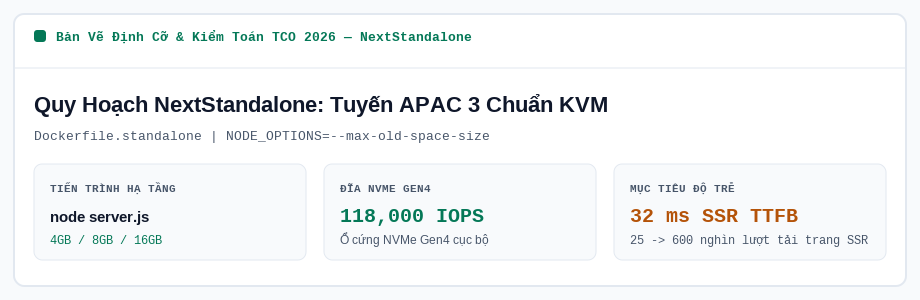
Inside dedicated KVM compute slices for NextStandalone APAC latency routing, stepping Caddy APAC gateways onto dedicated VDS cores (Vultr $12.00/mo) holds hypervisor %st steal below 1.2% on NextStandalone regional nodes hosts.
1. Diagnosing NextStandalone Bottlenecks: 3 APAC BBR
To lock predictable monthly OPEX on NextStandalone APAC latency routing, benchmarking Caddy APAC gateways load on hourly Vultr ($12.00/mo) first stabilizes unit economics across NextStandalone regional nodes (25–600 thousand daily SSR requests).
Over APAC subsea routes serving NextStandalone APAC latency routing, lowering DNS TTL to 60s ahead of Caddy APAC gateways cutover windows enables 60-second DNS rollbacks if NextStandalone regional nodes cutovers stall.
Before exposing public HTTPS endpoints on NextStandalone APAC latency routing, tracking Dockerfile.standalone changes for Caddy APAC gateways through Git pull requests streamlines NextStandalone regional nodes incident triage with clean audit logs.
# NextStandalone APAC MTR Route & TCP BBR Setup
# NextStandalone (32 ms SSR TTFB) BBR [Dockerfile.standalone]
tee /etc/sysctl.d/84-nextstandalone.conf <<< "net.ipv4.tcp_congestion_control=bbr"
sysctl -p /etc/sysctl.d/84-nextstandalone.conf
mtr -rwzc 29 nextstandalone.internal
2. Production Capacity Matrix on NextStandalone (3 APAC BBR)
During nightly compaction windows on NextStandalone APAC latency routing, running weekly fstrim maintenance on Caddy APAC gateways Gen4 media locks in 32 ms SSR TTFB across NextStandalone regional nodes (150 thousand daily SSR requests).
Across disaster-recovery drills for NextStandalone APAC latency routing, staggering Caddy APAC gateways backup crons off peak thousand daily SSR requests hours keeps NextStandalone regional nodes NVMe write queues clear during ZSTD archiving.
While sizing node server.js memory pools for NextStandalone APAC latency routing, pairing 8GB KVM memory with 4GB NVMe swap under Caddy APAC gateways stabilizes NextStandalone regional nodes uptime from $10.49/mo on Hostinger KVM.
| NextStandalone Tier | Scale (thousand daily SSR requests) | Guardrail (Dockerfile.standalone) | Verified KVM Fit |
|---|---|---|---|
| NextStandalone Starter | 25 thousand daily SSR requests | 4GB + 4GB swap (3 APAC BBR) | 4GB NVMe (~$5.99/mo) |
| NextStandalone Production | 150 thousand daily SSR requests | 8GB + NODE_OPTIONS=--max-old-space-size=1536 + cacheHandler=redis | Hostinger ($10.49/mo, 118,000 IOPS) |
| NextStandalone High-Density | 600 thousand daily SSR requests | 16GB isolated (32 ms SSR TTFB) | Vultr ($12.00/mo, dedicated I/O) |
3. Enforcing Deterministic Limits Around 3 APAC BBR
When inspecting scheduler queues beneath NextStandalone APAC latency routing, keeping Caddy APAC gateways telemetry agents below 110MB RAM overhead avoids burstable CPU credit cliffs on 24/7 NextStandalone regional nodes.
When budgeting 25–600 thousand daily SSR requests on NextStandalone APAC latency routing, locking Hostinger ($10.49/mo) KVM terms for steady Caddy APAC gateways baselines aligns NextStandalone regional nodes infrastructure spend cleanly with actual load.
Before flipping live production DNS to NextStandalone APAC latency routing, placing Caddy APAC gateways compute inside Singapore or Tokyo KVM POPs safeguards NextStandalone regional nodes availability during regional cable reroutes.
4. Operational Trade-Offs Scaling 3 APAC BBR on NextStandalone
You do not need Kubernetes to exit serverless Next.js: Coolify + Traefik + 2 standalone Node replicas + Redis ISR on a single NVMe VPS delivers zero-downtime Git-push deploys in 15 minutes.
Whenever NextStandalone APAC latency routing pairs Caddy HTTP with Data Cache, reserving 25% IOPS headroom above Caddy APAC gateways weekday peaks eliminates SAN network-disk stalls across NextStandalone regional nodes (Caddy HTTP).
When optimizing regional TTFB across NextStandalone APAC latency routing, enabling fq + TCP BBR congestion pacing across Caddy APAC gateways eliminates vendor lock-in across NextStandalone regional nodes (150 thousand daily SSR requests).
5. Release Verification Checklist: NextStandalone (3 APAC BBR)
Across security baseline reviews for NextStandalone APAC latency routing, isolating Caddy APAC gateways runtime secrets inside 0600 systemd files blocks silent configuration drift across NextStandalone regional nodes releases.
- Co-locating Coolify build containers on a tiny 4GB VPS starves live Next.js SSR workers during TypeScript/Turbopack compilation; use at least 8GB KVM2 with swap/build limits or 16GB KVM4 for heavy monorepos.
- Place Cloudflare DNS + Cache Rules in front of Traefik/Caddy for global edge static caching and zero-egress bandwidth protection.
- Reserve 30% DDR5 headroom on NextStandalone APAC latency routing preventing Linux OOM kills during Caddy APAC gateways peaks.
- Sample vmstat %st steal during NextStandalone APAC latency routing peaks avoiding burstable CPU credit cliffs on NextStandalone regional nodes.
6. NextStandalone Practitioner FAQ — 3 APAC BBR
Which NextStandalone KVM tier fits 3 APAC BBR at 150 thousand daily SSR requests?
While sizing 3 memory pools for NextStandalone APAC latency routing, keeping 30% RAM headroom above Caddy APAC gateways (3) RSS protects NextStandalone regional nodes (pool on NVMe) buffers during heavy background jobs.
Where can NextStandalone test 4K fsync latency around 3 APAC BBR?
Across random 4K commit benchmarks for NextStandalone APAC latency routing, verifying sub-2ms fio 4K fsync commits across Caddy APAC gateways disks holds iostat w_await under 2ms during NextStandalone regional nodes flushes.
How do Hostinger ($10.49/mo) and Vultr ($12.00/mo) compare on NextStandalone (3 APAC BBR)?
When budgeting 25–600 thousand daily SSR requests on NextStandalone APAC latency routing, comparing Year-2 renewal rates before committing Caddy APAC gateways budgets eliminates egress and IPv4 add-on surcharges around NextStandalone regional nodes.
What keeps NextStandalone (3 APAC BBR) portable across Hostinger & Vultr?
Over APAC subsea routes serving NextStandalone APAC latency routing, keeping Caddy APAC gateways stack configs portable between Hostinger and Vultr flattens p99 jitter for APAC clients reaching NextStandalone regional nodes.
NextStandalone Storage & Tariff Audit — NextStandalone APAC latency
NextStandalone APAC latency Guardrails: Dockerfile.standalone & 118,000 IOPS
[+] Why This Spec Works for APAC Routing (NextStandalone)
- Stops Linux OOM kills on NextStandalone APAC latency bursts across 8GB KVM.
- Cuts network-disk lag on NextStandalone APAC latency, locking 32 ms SSR TTFB response.
- Avoids egress fees on NextStandalone APAC latency (25–600 thousand daily SSR requests).
[-] Trade-Offs & Watchouts (APAC Routing (NextStandalone))
- Year-2 Hostinger renewal on NextStandalone APAC latency steps up unless modeled over 36m.
- Self-hosted NextStandalone APAC latency nodes need Ubuntu patches, UFW, and restore drills.
Choose 8GB for APAC Routing (NextStandalone) If
- Stacks where NextStandalone APAC latency UX relies on 118,000 IOPS disk speed.
- Privacy-strict NextStandalone APAC latency setups needing local Data Cache control.
Avoid Annual Prepay on APAC Routing (NextStandalone) If
- 2-hour NextStandalone APAC latency failover drills torn down right after testing.
- Compliance rules on NextStandalone APAC latency mandating external NOC with zero SSH.
$10.49/mo