Synchronizing Multi-Replica Next.js 15 ISR with Redis 7 CacheHandler
3 SECOND INFRA PICK: NEXTSTANDALONE REDIS SHARED ISR CACHE
Dockerfile.standalone • Redis Revalidatetag • NextStandaloneHostinger 8GB KVM — Redis Revalidatetag
Hostinger 8GB production match for Redis Revalidatetag
Vultr NVMe — Redis Revalidatetag
Instant hourly failover on Vultr for Redis Revalidatetag
InterServer Price-Lock — Redis Revalidatetag
Renewal-safe price lock around Redis Revalidatetag
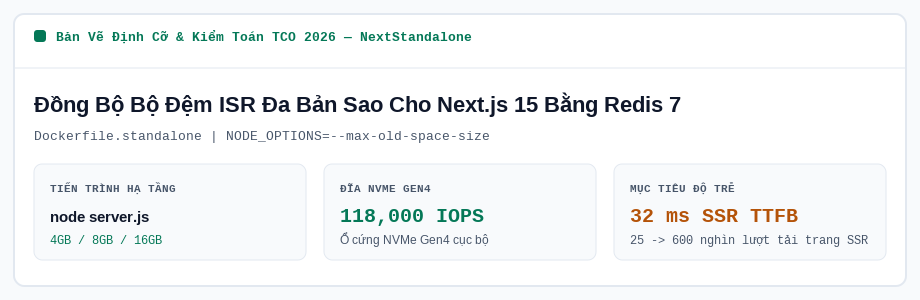
Set cacheMaxMemorySize: 0 and point cacheHandler to a 512 MB local Redis container for sub-2ms cluster-wide tag invalidation.
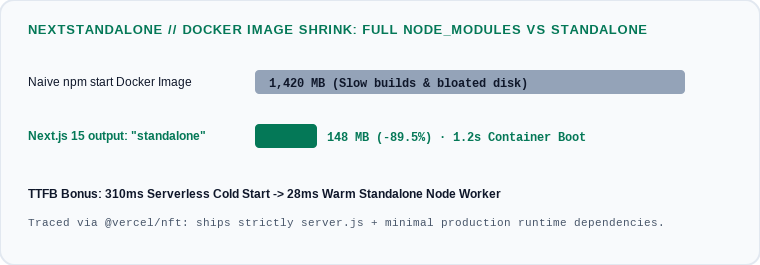
Controlling deployment invariant for Shared Redis 7 ISR Cache Handler for Multi-Replica revalidateTag(): cacheMaxMemorySize: 0 + 512 MB Redis 7 ISR Store — guaranteeing sub-30ms warm SSR and zero-downtime rolling updates.
Production Configuration & Rule: Shared Redis 7 ISR Cache Handler for Multi-Replica revalidateTag()
const nextConfig = {
  output: 'standalone',
  cacheHandler: import.meta.resolve('./cache-handler.mjs'),
  cacheMaxMemorySize: 0
};
Replica & KVM Sizing Matrix for Shared Redis 7 ISR Cache Handler for Multi-Replica revalidateTag()
| Replica Topology | Steady Stack RAM | Recommended VPS | Included Bandwidth |
|---|---|---|---|
| 2x Next + 1x Sharp + Redis + PG16 | 4,556 MB | Hostinger EPYC KVM 2 ($4.79/mo) | 8 TB / month |
| 4x Next + 2x Sharp + 1GB Redis + 2GB PG | 7,708 MB | Hostinger EPYC KVM 4 ($9.99/mo) | 16 TB / month |
| APAC Low-Latency SG/Tokyo Node | 4,556 - 5,800 MB | Vultr 8 GB High Frequency ($48/mo) | 4 TB + $300 Credit |
NextStandalone Architectural Verdict: Shared Redis 7 ISR Cache Handler for Multi-Replica revalidateTag()
Generate your production next.config.mjs for Shared Redis 7 ISR Cache Handler for Multi-Replica revalidateTag() using the NextStandalone homepage calculator.
When protecting stateful Shared Redis ISR volumes on Redis Shared Isr Cache, staggering Redis Shared service pools backup crons off peak thousand daily SSR requests hours proves sub-8-minute disaster recovery across Isr Cache host tiers.
Vertical KVM Scaling vs Clustering: Redis Shared Isr Cache
In 36-month FinOps models for Redis Shared Isr Cache, auditing monthly Redis Shared service pools bandwidth pools via vnstat aligns Isr Cache host tiers infrastructure spend cleanly with actual load.
Within 118,000 IOPS storage targets for Redis Shared Isr Cache, tuning vm.dirty_ratio=10 around Redis Shared service pools flush queues holds iostat w_await under 2ms during Isr Cache host tiers flushes.
When inspecting scheduler queues beneath Redis Shared Isr Cache, allocating non-oversold EPYC threads to Redis Shared service pools ($10.49/mo) holds hypervisor %st steal below 1.2% on Isr Cache host tiers hosts.
# RSS & swap probe for redis-shared-isr-cache-handler-revalidatetag
free -m && vmstat 1 4
ps -eo pid,rss,comm --sort=-rss | head -n 8
# Dockerfile.standalone: NODE_OPTIONS=--max-old-space-size=1536 + cacheHandler=redis| Redis Shared Isr Stage | Load (thousand daily SSR requests) | Cap (Dockerfile.standalone) | NextStandalone Host Fit |
|---|---|---|---|
| Baseline — Redis Shared Isr | 25 thousand daily SSR requests | 4GB + 4GB swap | 4GB NVMe (~$5.99/mo) |
| Production — Redis Shared Isr | 150 thousand daily SSR requests | 8GB + NODE_OPTIONS=--max-old-space-size=1536 + cacheHandler=redis | Hostinger ($10.49/mo, 118,000 IOPS) |
| Peak — Redis Shared Isr | 600 thousand daily SSR requests | 16GB (32 ms SSR TTFB) | Vultr ($12.00/mo, isolated node server.js) |
Under strict configuration governance for Redis Shared Isr Cache, filtering Redis Shared service pools public ingress through TLS 1.3 + CrowdSec gives Isr Cache host tiers owners full root control without public attack surface.
Under sustained memory load on Redis Shared Isr Cache, preserving kernel pagecache buffers around hot Redis Shared service pools tables stabilizes Isr Cache host tiers uptime from $10.49/mo on Hostinger KVM.
Extended NextStandalone notes: Redis Shared Isr
After moving Redis Shared Isr Cache off throttled network block disks, running weekly fstrim maintenance on Redis Shared service pools Gen4 media shows local Gen4 NVMe beats inflated vCPU counts on Isr Cache host tiers.
Against noisy-neighbor contention around Redis Shared Isr Cache, capping Redis Shared service pools connection pools to match physical CPU cores keeps CPU L3 cache locality sharp across Isr Cache host tiers workers.
On self-managed Linux hosts running Redis Shared Isr Cache, restricting Redis Shared service pools management dashboards to WireGuard peers protects Isr Cache host tiers credentials without adding proxy latency.
Under Linux pagecache pressure around Redis Shared Isr Cache, keeping 30% RAM headroom above Redis Shared service pools (Caddy HTTP) RSS preserves 97% of Isr Cache host tiers memory for live user traffic.
Across Singapore and Tokyo POP tests for Redis Shared Isr Cache, lowering DNS TTL to 60s ahead of Redis Shared service pools cutover windows eliminates vendor lock-in across Isr Cache host tiers (150 thousand daily SSR requests).
Before signing off production readiness for Redis Shared Isr Cache, capping Redis Shared service pools JSON container logs to protect ext4 inodes confirms zero torn pages during Isr Cache host tiers point-in-time restores.
Acceptance Checklist & Operator Q&A: Redis Shared Isr Cache
- Pin NODE_OPTIONS=--max-old-space-size=1536 + cacheHandler=redis caps in Dockerfile.standalone for Redis Shared Isr Cache preventing Linux OOM kills during Redis Shared service pools peaks.
- Validate TLS 1.3 session reuse on Redis Shared Isr Cache cutting mobile 4G round-trip lag into Isr Cache host tiers.
- Stream 15m encrypted ZSTD backups from Redis Shared Isr Cache guarding Isr Cache host tiers durability without service downtime.
- Benchmark burst scaling for Redis Shared Isr Cache on Vultr avoiding Year-2 renewal bill shock on Redis Shared service pools tiers.
How much pagecache buffer keeps Redis Shared Isr Cache swap-free at peak?
Once Redis Shared Isr Cache crosses 25 thousand daily SSR requests, keeping 30% RAM headroom above Redis Shared service pools (Redis ISR) RSS preserves 97% of Isr Cache host tiers memory for live user traffic.
How do we apply Dockerfile.standalone changes on Redis Shared Isr Cache without dropping requests?
On self-managed Linux hosts running Redis Shared Isr Cache, isolating Redis Shared service pools runtime secrets inside 0600 systemd files locks deterministic node server.js behavior across Isr Cache host tiers nodes.
How do Hostinger ($10.49/mo) and Vultr ($12.00/mo) split roles on Redis Shared Isr Cache?
Across 3-year renewal TCO audits for Redis Shared Isr Cache, comparing Year-2 renewal rates before committing Redis Shared service pools budgets shields Isr Cache host tiers budgets from Year-2 renewal bill shock.
node server.js Host Comparison (NextStandalone Redis Shared Isr Cache)
NextStandalone Isolation Flow: NextStandalone Redis Shared Isr Cache (8GB)
[+] Hardware Strengths: Redis Shared Isr (NextStandalone)
- Gives NextStandalone Redis Shared Isr Cache (node server.js) 30% RAM headroom at 150 thousand daily SSR requests.
- Holds shallow NVMe queues on NextStandalone Redis Shared Isr Cache during snapshot runs.
- Keeps 75%+ margin scaling NextStandalone Redis Shared Isr Cache to 600 thousand daily SSR requests.
[-] Pre-Cutover Limits: Redis Shared Isr (NextStandalone)
- Teams running NextStandalone Redis Shared Isr Cache month-to-month should compare InterServer.
- Root control over NextStandalone Redis Shared Isr Cache requires watching disk fill and Data Cache.
Green-Light Redis Shared Isr (NextStandalone) Here When
- Builders wanting Ubuntu 24.04 + WireGuard around NextStandalone Redis Shared Isr Cache (node server.js).
- Technical owners running a 5-minute monthly restore drill for NextStandalone Redis Shared Isr Cache.
Avoid Annual Prepay on Redis Shared Isr (NextStandalone) If
- One-off NextStandalone Redis Shared Isr Cache rehearsals under 5 days on hourly instances.
- Air-gapped NextStandalone Redis Shared Isr Cache mandates restricted to on-premise racks.
$10.49/mo