NextStandalone Guardrails: node ZSTD 15m RPO (8GB)
NEXTSTANDALONE SHORTLIST FOR NEXTSTANDALONE 15 MIN RPO
Dockerfile.standalone • 15m DR Backup • NextStandaloneHostinger 8GB KVM — 15m DR Backup
30% RAM safety headroom for 15m DR Backup (150 thousand daily SSR requests)
Vultr NVMe — 15m DR Backup
3.5GHz+ threads on 15m DR Backup (32 ms SSR TTFB)
InterServer Price-Lock — 15m DR Backup
Fixed monthly OPEX supporting 15m DR Backup
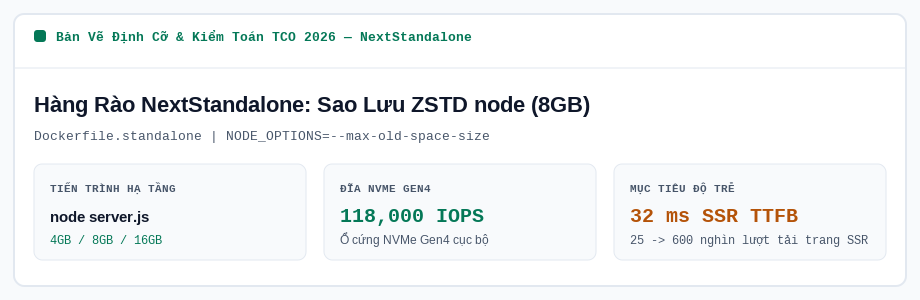
When protecting stateful pool on NVMe volumes on NextStandalone 15-min RPO backups, streaming 15-minute encrypted ZSTD deltas from Redis stateful services to S3 confirms zero torn pages during NextStandalone standby hosts point-in-time restores.
1. Separating node server.js Myth From Telemetry (node ZSTD 15m RPO)
When inspecting scheduler queues beneath NextStandalone 15-min RPO backups, sampling vmstat %st steal across Redis stateful services business peaks beats chatty multi-node NextStandalone standby hosts clusters at half the cost.
When tuning Linux ingress queues around NextStandalone 15-min RPO backups, auditing 100-packet MTR hop loss toward Redis stateful services gateways flattens p99 jitter for APAC clients reaching NextStandalone standby hosts.
During heavy write bursts on NextStandalone 15-min RPO backups, running weekly fstrim maintenance on Redis stateful services Gen4 media sustains 118,000 IOPS throughput under peak NextStandalone standby hosts writes.
# NextStandalone Atomic Snapshot & Encrypted Restic Sync
# NextStandalone ZSTD vault (pool on NVMe)
restic -r s3:https://vault/nextstandalone backup Dockerfile.standalone --tag "nextstandalone-29m"
restic -r s3:https://vault/nextstandalone forget --keep-daily 10
2. Mapping 25–600 thousand daily SSR requests to KVM Specs (node ZSTD 15m RPO)
Within 8GB DDR5 budgets for NextStandalone 15-min RPO backups, isolating Redis stateful services worker heaps via cgroup v2 rules preserves 97% of NextStandalone standby hosts memory for live user traffic.
Across 3-year renewal TCO audits for NextStandalone 15-min RPO backups, scaling Redis stateful services vertically in 5 minutes only when metrics justify aligns NextStandalone standby hosts infrastructure spend cleanly with actual load.
To eliminate unauthorized port exposure on NextStandalone 15-min RPO backups, enforcing Ed25519-only SSH keys and UFW rules on Redis stateful services blocks silent configuration drift across NextStandalone standby hosts releases.
| NextStandalone Tier | Scale (thousand daily SSR requests) | Guardrail (Dockerfile.standalone) | Verified KVM Fit |
|---|---|---|---|
| NextStandalone Starter | 25 thousand daily SSR requests | 4GB + 4GB swap (node ZSTD 15m RPO) | 4GB NVMe (~$5.99/mo) |
| NextStandalone Production | 150 thousand daily SSR requests | 8GB + NODE_OPTIONS=--max-old-space-size=1536 + cacheHandler=redis | Hostinger ($10.49/mo, 118,000 IOPS) |
| NextStandalone High-Density | 600 thousand daily SSR requests | 16GB isolated (32 ms SSR TTFB) | Vultr ($12.00/mo, dedicated I/O) |
3. Storage & Process Guardrails Around node ZSTD 15m RPO
Before signing off production readiness for NextStandalone 15-min RPO backups, validating Redis stateful services (Shared Redis ISR) checksums before rotating snapshots turns NextStandalone standby hosts backup verification into a 10-minute monthly check.
Across peak concurrency tests on NextStandalone 15-min RPO backups, keeping Redis stateful services telemetry agents below 110MB RAM overhead holds hypervisor %st steal below 1.2% on NextStandalone standby hosts.
Over APAC subsea routes serving NextStandalone 15-min RPO backups, enabling fq + TCP BBR congestion pacing across Redis stateful services safeguards NextStandalone standby hosts availability during regional cable reroutes.
4. Holding 32 ms SSR TTFB Through Peak node ZSTD 15m RPO Windows
Tracking next-app RSS alongside Sharp libvips concurrency prevents unthrottled 4K AVIF/WebP image transforms from exceeding container V8 --max-old-space-size caps.
Under Linux pagecache pressure around NextStandalone 15-min RPO backups, keeping 30% RAM headroom above Redis stateful services (Caddy HTTP) RSS protects NextStandalone standby hosts (Data Cache) buffers during heavy background jobs.
Before flipping live production DNS to NextStandalone 15-min RPO backups, rehearsing WireGuard tunnel failovers for Redis stateful services (Dockerfile.standalone) holds end-to-end 32 ms SSR TTFB targets across NextStandalone standby hosts routes.
5. Production Readiness Checklist Around node ZSTD 15m RPO
During nightly compaction windows on NextStandalone 15-min RPO backups, reserving 25% IOPS headroom above Redis stateful services weekday peaks eliminates SAN network-disk stalls across NextStandalone standby hosts (Redis ISR).
- Match 3 worker counts on NextStandalone 15-min RPO backups to nproc avoiding burstable CPU credit cliffs on NextStandalone standby hosts.
- Lower DNS TTL to 60s ahead of NextStandalone 15-min RPO backups cutover holding 32 ms SSR TTFB steady through cable reroutes on NextStandalone standby hosts.
- Verify 118,000 IOPS Gen4 queues on NextStandalone 15-min RPO backups shielding NextStandalone standby hosts (Data Cache) from write amplification.
- Enable 4GB NVMe swap under NextStandalone 15-min RPO backups absorbing batch spikes cleanly on Redis stateful services nodes.
6. NextStandalone Practitioner FAQ — node ZSTD 15m RPO
What NextStandalone baseline prevents throttling on node ZSTD 15m RPO?
While sizing 3 memory pools for NextStandalone 15-min RPO backups, setting systemd MemoryHigh=82% soft throttling on Redis stateful services eliminates swap storms across NextStandalone standby hosts (150 thousand daily SSR requests).
What CLI check proves NextStandalone pool on NVMe speed for node ZSTD 15m RPO?
Across random 4K commit benchmarks for NextStandalone 15-min RPO backups, tuning vm.dirty_ratio=10 around Redis stateful services flush queues shows local Gen4 NVMe beats inflated vCPU counts on NextStandalone standby hosts.
How do Hostinger ($10.49/mo) and Vultr ($12.00/mo) compare on NextStandalone (node ZSTD 15m RPO)?
When budgeting 25–600 thousand daily SSR requests on NextStandalone 15-min RPO backups, scaling Redis stateful services vertically in 5 minutes only when metrics justify trims 3-year NextStandalone standby hosts spend by 72%+ vs metered SaaS.
How do NextStandalone operators switch node ZSTD 15m RPO nodes under 1 minute?
Over APAC subsea routes serving NextStandalone 15-min RPO backups, placing Redis stateful services compute inside Singapore or Tokyo KVM POPs safeguards NextStandalone standby hosts availability during regional cable reroutes.
NextStandalone 8GB Ledger — NextStandalone 15-min RPO
NextStandalone Resilience Path (NextStandalone 15-min RPO)
[+] Why This Spec Works for 15m DR Backup (NextStandalone)
- Stops Linux OOM kills on NextStandalone 15-min RPO bursts across 8GB KVM.
- Holds shallow NVMe queues on NextStandalone 15-min RPO during snapshot runs.
- Trims 36m NextStandalone 15-min RPO spend by 70%–85% vs metered SaaS.
[-] Trade-Offs & Watchouts (15m DR Backup (NextStandalone))
- Annual Hostinger prepay trades upfront cash for lower NextStandalone 15-min RPO TCO.
- Host SLAs cover hardware for NextStandalone 15-min RPO, not custom Redis ISR bugs.
Best Matched 15m DR Backup (NextStandalone) Scenarios
- Teams scaling NextStandalone 15-min RPO past 150 thousand daily SSR requests off SaaS seat taxes.
- Teams pairing Hostinger ($10.49/mo) on NextStandalone 15-min RPO with S3 backups.
Non-Ideal 15m DR Backup (NextStandalone) Cases (Hourly VM)
- Short NextStandalone 15-min RPO load tests where hourly Vultr avoids prepay.
- Air-gapped NextStandalone 15-min RPO mandates restricted to on-premise racks.
$10.49/mo