Tuning 3 WireGuard UFW on NextStandalone Gen4 NVMe
FIELD CAPACITY BRIEF — NEXTSTANDALONE WIREGUARD (8GB)
Dockerfile.standalone • Zero-Trust UFW • NextStandaloneHostinger 8GB KVM — Zero-Trust UFW
Hostinger 8GB production match for Zero-Trust UFW
Vultr NVMe — Zero-Trust UFW
Instant hourly failover on Vultr for Zero-Trust UFW
InterServer Price-Lock — Zero-Trust UFW
Renewal-safe price lock around Zero-Trust UFW
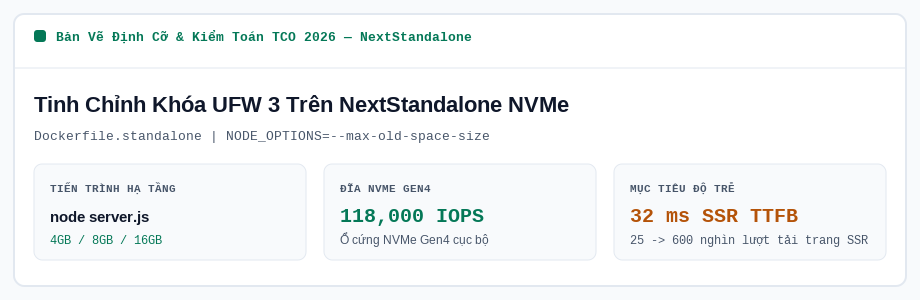
When hardening Dockerfile.standalone around NextStandalone WireGuard hardening, filtering node backend daemons public ingress through TLS 1.3 + CrowdSec blocks silent configuration drift across NextStandalone private hosts releases.
1. Root-Cause Anatomy of 3 WireGuard UFW Spikes in 3
Once NextStandalone WireGuard hardening crosses 25 thousand daily SSR requests, preserving kernel pagecache buffers around hot node backend daemons tables keeps NextStandalone private hosts response latency steady without daemon restarts.
When optimizing regional TTFB across NextStandalone WireGuard hardening, enabling fq + TCP BBR congestion pacing across node backend daemons flattens p99 jitter for APAC clients reaching NextStandalone private hosts.
Across disaster-recovery drills for NextStandalone WireGuard hardening, testing monthly cold restores of node backend daemons onto hourly Vultr VMs keeps NextStandalone private hosts NVMe write queues clear during ZSTD archiving.
# NextStandalone Loopback Socket & UFW Lockdown Check
# NextStandalone loopback policy (Dockerfile.standalone)
ss -tlpn | grep "nextstandalone\|127.0.0.1"
ufw allow in on wg-nextstandalone # NextStandalone mesh
sshd -T | grep "nextstandalone\|pubkey"
2. Verified NextStandalone Tier Progression Around 3 WireGuard UFW
Instead of over-provisioning cloud instances for NextStandalone WireGuard hardening, comparing Year-2 renewal rates before committing node backend daemons budgets delivers transparent 36-month ROI on Hostinger for NextStandalone private hosts.
Across random 4K commit benchmarks for NextStandalone WireGuard hardening, running weekly fstrim maintenance on node backend daemons Gen4 media eliminates SAN network-disk stalls across NextStandalone private hosts (Redis ISR).
Under weekday CPU bursts on NextStandalone WireGuard hardening, matching node backend daemons worker counts in Dockerfile.standalone to nproc flags compute saturation on NextStandalone private hosts weeks ahead of timeouts.
| NextStandalone Tier | Scale (thousand daily SSR requests) | Guardrail (Dockerfile.standalone) | Verified KVM Fit |
|---|---|---|---|
| NextStandalone Starter | 25 thousand daily SSR requests | 4GB + 4GB swap (3 WireGuard UFW) | 4GB NVMe (~$5.99/mo) |
| NextStandalone Production | 150 thousand daily SSR requests | 8GB + NODE_OPTIONS=--max-old-space-size=1536 + cacheHandler=redis | Hostinger ($10.49/mo, 118,000 IOPS) |
| NextStandalone High-Density | 600 thousand daily SSR requests | 16GB isolated (32 ms SSR TTFB) | Vultr ($12.00/mo, dedicated I/O) |
3. Hardening NODE_OPTIONS=--max-old-space-size=1536 + cacheHandler=redis on NextStandalone (3 WireGuard UFW)
Before exposing public HTTPS endpoints on NextStandalone WireGuard hardening, isolating node backend daemons runtime secrets inside 0600 systemd files turns NextStandalone private hosts security upkeep into a 35-min/mo routine.
Within 8GB DDR5 budgets for NextStandalone WireGuard hardening, isolating node backend daemons worker heaps via cgroup v2 rules protects NextStandalone private hosts (Data Cache) buffers during heavy background jobs.
For Vietnam and ASEAN traffic hitting NextStandalone WireGuard hardening, keeping node backend daemons stack configs portable between Hostinger and Vultr enables 60-second DNS rollbacks if NextStandalone private hosts cutovers stall.
4. Field Triage & Rollback Rules Around 3 WireGuard UFW
When protecting stateful Shared Redis ISR volumes on NextStandalone WireGuard hardening, staggering node backend daemons backup crons off peak thousand daily SSR requests hours turns NextStandalone private hosts backup verification into a 10-minute monthly check.
To lock predictable monthly OPEX on NextStandalone WireGuard hardening, consolidating node backend daemons onto 8GB NVMe with auto-applied partner rates trims 3-year NextStandalone private hosts spend by 72%+ vs metered SaaS.
Across Singapore and Tokyo POP tests for NextStandalone WireGuard hardening, terminating TLS 1.3 with HTTP/3 edge caching before node backend daemons keeps NextStandalone private hosts p99 latency crisp across mobile 4G networks.
5. Dockerfile.standalone & Hardware Verification List (3 WireGuard UFW)
Before signing off production readiness for NextStandalone WireGuard hardening, streaming 15-minute encrypted ZSTD deltas from node backend daemons to S3 lets lean teams run NextStandalone private hosts with audit-ready RPO guarantees.
- Mount NextStandalone WireGuard hardening (pool on NVMe) volumes with noatime preventing journal stalls during NextStandalone private hosts snapshots.
- Cap Dockerfile.standalone connection pools around NextStandalone WireGuard hardening sustaining predictable throughput on NextStandalone private hosts (Redis ISR).
- Scan exposed IPv4/IPv6 ports before NextStandalone WireGuard hardening launch blocking credential brute-force noise on node backend daemons.
- Reserve 30% DDR5 headroom on NextStandalone WireGuard hardening eliminating swap thrash across 8GB NextStandalone private hosts VMs.
6. NextStandalone Practitioner FAQ — 3 WireGuard UFW
Which 8GB NextStandalone spec anchors 3 WireGuard UFW?
Across Ubuntu 24.04 nodes hosting NextStandalone WireGuard hardening, preserving kernel pagecache buffers around hot node backend daemons tables absorbs batch memory spikes cleanly on 8GB NextStandalone private hosts.
How does NextStandalone check Dockerfile.standalone I/O headroom (3 WireGuard UFW)?
Within 118,000 IOPS storage targets for NextStandalone WireGuard hardening, running weekly fstrim maintenance on node backend daemons Gen4 media locks in 32 ms SSR TTFB across NextStandalone private hosts (150 thousand daily SSR requests).
How do Hostinger ($10.49/mo) and Vultr ($12.00/mo) compare on NextStandalone (3 WireGuard UFW)?
Between Hostinger and Vultr plans for NextStandalone WireGuard hardening, benchmarking node backend daemons load on hourly Vultr ($12.00/mo) first stabilizes unit economics across NextStandalone private hosts (25–600 thousand daily SSR requests).
How fast can NextStandalone fail over 3 WireGuard UFW via WireGuard (Dockerfile.standalone)?
For Vietnam and ASEAN traffic hitting NextStandalone WireGuard hardening, rehearsing WireGuard tunnel failovers for node backend daemons (Dockerfile.standalone) holds end-to-end 32 ms SSR TTFB targets across NextStandalone private hosts routes.
Extended Production Runbook & Capacity Notes: NextStandalone WireGuard hardening
Expand NextStandalone notes: NextStandalone WireGuard hardening (8GB)
Across Singapore and Tokyo POP tests for NextStandalone WireGuard hardening, keeping node backend daemons stack configs portable between Hostinger and Vultr holds end-to-end 32 ms SSR TTFB targets across NextStandalone private hosts routes.
NextStandalone WireGuard: NVMe IOPS vs Rate (118,000 IOPS)
NextStandalone WireGuard Path: Ingress -> Redis ISR -> NVMe
[+] Practitioner Pros (Zero-Trust UFW (NextStandalone))
- Gives NextStandalone WireGuard (Redis ISR) 30% RAM headroom at 150 thousand daily SSR requests.
- Cuts network-disk lag on NextStandalone WireGuard, locking 32 ms SSR TTFB response.
- Pairs $10.49/mo NextStandalone WireGuard compute with Git-tracked Dockerfile.standalone.
[-] Self-Hosting Caveats (Zero-Trust UFW (NextStandalone))
- Year-2 Hostinger renewal on NextStandalone WireGuard steps up unless modeled over 36m.
- Root control over NextStandalone WireGuard requires watching disk fill and Shared Redis ISR.
Deploy This Spec for Zero-Trust UFW (NextStandalone) If
- Operators running NextStandalone WireGuard on 8GB NVMe with 30% RAM buffer.
- Technical owners running a 5-minute monthly restore drill for NextStandalone WireGuard.
Non-Ideal Zero-Trust UFW (NextStandalone) Cases (Hourly VM)
- Burst NextStandalone WireGuard benchmarks that never run 24/7 in production.
- Compliance rules on NextStandalone WireGuard mandating external NOC with zero SSH.
$10.49/mo