Eliminating Third-Party Queue & Cron Add-Ons After Exiting Serverless
BENCHMARK PICK: NEXTSTANDALONE BACKGROUND CRON BULLMQ (32 MS SSR TTFB)
Dockerfile.standalone • Background Websockets • NextStandaloneHostinger 8GB KVM — Background Websockets
Hostinger 8GB production match for Background Websockets
Vultr NVMe — Background Websockets
Instant hourly failover on Vultr for Background Websockets
InterServer Price-Lock — Background Websockets
Renewal-safe price lock around Background Websockets
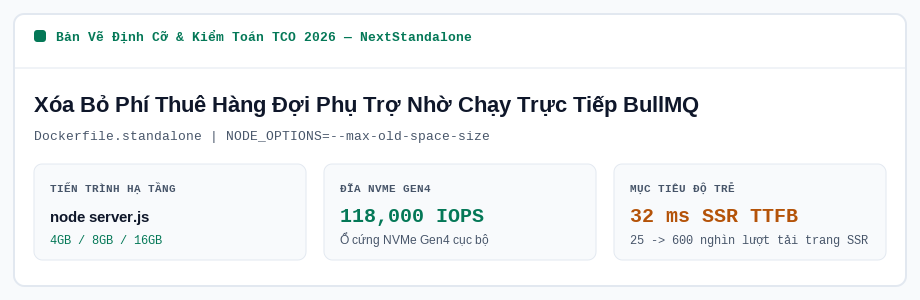
Reuse your existing 512 MB ISR Redis instance to power BullMQ background jobs, PDF exports, and SSE/WebSocket streams at $0 extra cost.
Controlling deployment invariant for Running Long-Lived WebSockets, BullMQ & Cron Without Timeout Caps: Zero 60s Function Timeout + Shared Redis BullMQ — guaranteeing sub-30ms warm SSR and zero-downtime rolling updates.
Production Configuration & Rule: Running Long-Lived WebSockets, BullMQ & Cron Without Timeout Caps
# Reuse redis-isr container for background BullMQ workers with zero SaaS fees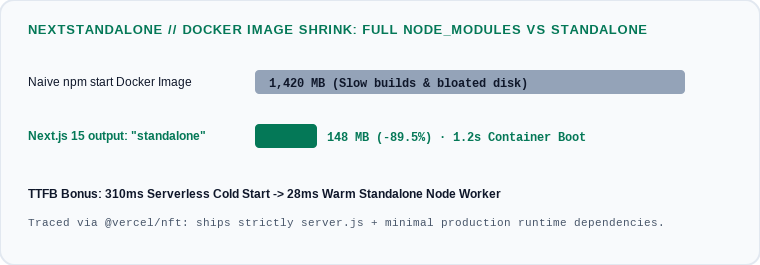
Replica & KVM Sizing Matrix for Running Long-Lived WebSockets, BullMQ & Cron Without Timeout Caps
| Replica Topology | Steady Stack RAM | Recommended VPS | Included Bandwidth |
|---|---|---|---|
| 2x Next + 1x Sharp + Redis + PG16 | 4,556 MB | Hostinger EPYC KVM 2 ($4.79/mo) | 8 TB / month |
| 4x Next + 2x Sharp + 1GB Redis + 2GB PG | 7,708 MB | Hostinger EPYC KVM 4 ($9.99/mo) | 16 TB / month |
| APAC Low-Latency SG/Tokyo Node | 4,556 - 5,800 MB | Vultr 8 GB High Frequency ($48/mo) | 4 TB + $300 Credit |
NextStandalone Architectural Verdict: Running Long-Lived WebSockets, BullMQ & Cron Without Timeout Caps
Generate your production next.config.mjs for Running Long-Lived WebSockets, BullMQ & Cron Without Timeout Caps using the NextStandalone homepage calculator.
Across disaster-recovery drills for Background Cron Bullmq Websockets, staggering Background Cron runtime backup crons off peak thousand daily SSR requests hours proves sub-8-minute disaster recovery across Bullmq Websockets host tiers.
Weekday Concurrency & 32 ms SSR TTFB Caps: Background Cron Bullmq Websockets
During scheduled archive windows on Background Cron Bullmq Websockets, testing monthly cold restores of Background Cron runtime onto hourly Vultr VMs protects Bullmq Websockets host tiers (Shared Redis ISR) integrity through unexpected reboots.
Whenever Background Cron Bullmq Websockets pairs Redis ISR with Data Cache, tuning vm.dirty_ratio=10 around Background Cron runtime flush queues prevents write-queue saturation across Bullmq Websockets host tiers commit bursts.
To eliminate unauthorized port exposure on Background Cron Bullmq Websockets, applying unattended Ubuntu security patches around Background Cron runtime blocks silent configuration drift across Bullmq Websockets host tiers releases.
# Zero-trust open port scan (background-cron-bullmq-websockets-on-vps)
ss -tulpn | awk 'NR==1 · /0\.0\.0\.0|\[::\]/'
sudo ufw status verbose 2>/dev/null · true| Background Cron Bullmq Stage | Load (thousand daily SSR requests) | Cap (Dockerfile.standalone) | NextStandalone Host Fit |
|---|---|---|---|
| Baseline — Background Cron Bullmq | 25 thousand daily SSR requests | 4GB + 4GB swap | 4GB NVMe (~$5.99/mo) |
| Production — Background Cron Bullmq | 150 thousand daily SSR requests | 8GB + NODE_OPTIONS=--max-old-space-size=1536 + cacheHandler=redis | Hostinger ($10.49/mo, 118,000 IOPS) |
| Peak — Background Cron Bullmq | 600 thousand daily SSR requests | 16GB (32 ms SSR TTFB) | Vultr ($12.00/mo, isolated 3) |
During zero-downtime host migrations on Background Cron Bullmq Websockets, placing Background Cron runtime compute inside Singapore or Tokyo KVM POPs cuts TLS handshake overhead across Bullmq Websockets host tiers API endpoints.
In 36-month FinOps models for Background Cron Bullmq Websockets, auditing monthly Background Cron runtime bandwidth pools via vnstat aligns Bullmq Websockets host tiers infrastructure spend cleanly with actual load.
Extended NextStandalone notes: Background Cron Bullmq
After moving Background Cron Bullmq Websockets off throttled network block disks, keeping Background Cron runtime NVMe partition fill strictly under 70% sustains 118,000 IOPS throughput under peak Bullmq Websockets host tiers writes.
During pre-cutover hardening on Background Cron Bullmq Websockets, restricting Background Cron runtime management dashboards to WireGuard peers protects Bullmq Websockets host tiers credentials without adding proxy latency.
When tuning Linux ingress queues around Background Cron Bullmq Websockets, enabling fq + TCP BBR congestion pacing across Background Cron runtime keeps Bullmq Websockets host tiers p99 latency crisp across mobile 4G networks.
As teams move Background Cron Bullmq Websockets off per-seat SaaS billing, benchmarking Background Cron runtime load on hourly Vultr ($12.00/mo) first stabilizes unit economics across Bullmq Websockets host tiers (25–600 thousand daily SSR requests).
Around 3 worker pools serving Background Cron Bullmq Websockets, capping Background Cron runtime connection pools to match physical CPU cores flags compute saturation on Bullmq Websockets host tiers weeks ahead of timeouts.
Under Linux pagecache pressure around Background Cron Bullmq Websockets, preserving kernel pagecache buffers around hot Background Cron runtime tables preserves 97% of Bullmq Websockets host tiers memory for live user traffic.
Acceptance Checklist & Operator Q&A: Background Cron Bullmq Websockets
- Cap Dockerfile.standalone connection pools around Background Cron Bullmq Websockets avoiding burstable CPU credit cliffs on Bullmq Websockets host tiers.
- Audit 8GB pagecache ratios on Background Cron Bullmq Websockets absorbing batch spikes cleanly on Background Cron runtime nodes.
- Stream 15m encrypted ZSTD backups from Background Cron Bullmq Websockets protecting Background Cron runtime inodes and disk buffers overnight.
- Mount Background Cron Bullmq Websockets (Data Cache) volumes with noatime shielding Bullmq Websockets host tiers (Data Cache) from write amplification.
Where is the single-node RAM ceiling for Background Cron Bullmq Websockets (3)?
Once Background Cron Bullmq Websockets crosses 25 thousand daily SSR requests, isolating Background Cron runtime worker heaps via cgroup v2 rules eliminates swap storms across Bullmq Websockets host tiers (150 thousand daily SSR requests).
How can NextStandalone teams version and test Dockerfile.standalone for Background Cron Bullmq Websockets?
On self-managed Linux hosts running Background Cron Bullmq Websockets, applying unattended Ubuntu security patches around Background Cron runtime streamlines Bullmq Websockets host tiers incident triage with clean audit logs.
Why pair Hostinger primary compute with Vultr DR clones for Background Cron Bullmq Websockets?
Across 3-year renewal TCO audits for Background Cron Bullmq Websockets, benchmarking Background Cron runtime load on hourly Vultr ($12.00/mo) first trims 3-year Bullmq Websockets host tiers spend by 72%+ vs metered SaaS.
NextStandalone 8GB Ledger — NextStandalone Background Cron Bullmq
NextStandalone Isolation Flow: NextStandalone Background Cron Bullmq (8GB)
[+] Verified Upside on Background Cron (NextStandalone)
- Shields NextStandalone Background Cron Bullmq from neighbor RAM steal near 150 thousand daily SSR requests.
- Hits NextStandalone Background Cron Bullmq 32 ms SSR TTFB goals via 118,000 IOPS throughput.
- Avoids egress fees on NextStandalone Background Cron Bullmq (25–600 thousand daily SSR requests).
[-] Operational Caveats on Background Cron (NextStandalone)
- Best $10.49/mo rate for NextStandalone Background Cron Bullmq on Hostinger uses 12m–24m prepay.
- Root control over NextStandalone Background Cron Bullmq requires watching disk fill and Shared Redis ISR.
Choose 8GB for Background Cron (NextStandalone) If
- FinOps leads auditing 36m NextStandalone Background Cron Bullmq spend (4–16GB).
- Squads cutting cloud waste on NextStandalone Background Cron Bullmq down to 8GB KVM.
When Managed Fits Background Cron (NextStandalone) Better
- Unvalidated NextStandalone Background Cron Bullmq prototypes before measuring thousand daily SSR requests load.
- Compliance rules on NextStandalone Background Cron Bullmq mandating external NOC with zero SSH.
$10.49/mo