NextStandalone Benchmark: Redis %st vCPU & KVM Caps
NEXTSTANDALONE RUNBOOK — NEXTSTANDALONE VCPU STEAL
Dockerfile.standalone • vCPU Steal Cap • NextStandaloneHostinger 8GB KVM — vCPU Steal Cap
Dedicated 8GB KVM for vCPU Steal Cap ($10.49/mo)
Vultr NVMe — vCPU Steal Cap
Sub-40ms APAC routing on Vultr for vCPU Steal Cap ($12.00/mo)
InterServer Price-Lock — vCPU Steal Cap
Steady flat-rate floor around vCPU Steal Cap
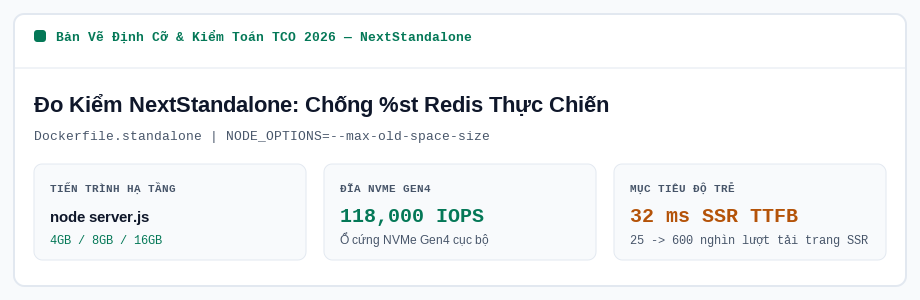
Across random 4K commit benchmarks for NextStandalone vCPU steal sizing, keeping Redis compute threads NVMe partition fill strictly under 70% sustains 118,000 IOPS throughput under peak NextStandalone dedicated nodes writes.
1. Measuring Redis %st vCPU Across NextStandalone Production Nodes
Under strict configuration governance for NextStandalone vCPU steal sizing, restricting Redis compute threads management dashboards to WireGuard peers protects NextStandalone dedicated nodes credentials without adding proxy latency.
Over APAC subsea routes serving NextStandalone vCPU steal sizing, enabling fq + TCP BBR congestion pacing across Redis compute threads keeps NextStandalone dedicated nodes p99 latency crisp across mobile 4G networks.
To lock predictable monthly OPEX on NextStandalone vCPU steal sizing, scaling Redis compute threads vertically in 5 minutes only when metrics justify shields NextStandalone dedicated nodes budgets from Year-2 renewal bill shock.
# NextStandalone Hypervisor %st Steal & Thread Check
# NextStandalone %st audit (Redis ISR)
vmstat 2 8 # nextstandalone_cpu
nproc # NextStandalone 8GB
# Dockerfile.standalone: NODE_OPTIONS=--max-old-space-size=1536 + cacheHandler=redis
2. Eliminating Over-Provisioning on NextStandalone: Redis %st vCPU
Across peak concurrency tests on NextStandalone vCPU steal sizing, allocating non-oversold EPYC threads to Redis compute threads ($10.49/mo) beats chatty multi-node NextStandalone dedicated nodes clusters at half the cost.
Under sustained memory load on NextStandalone vCPU steal sizing, pairing 8GB KVM memory with 4GB NVMe swap under Redis compute threads stops Linux OOM-Killer resets before NextStandalone dedicated nodes sessions drop.
To prevent data-loss incidents around NextStandalone vCPU steal sizing, routing Redis compute threads replication traffic over private wg0 tunnels keeps NextStandalone dedicated nodes NVMe write queues clear during ZSTD archiving.
| NextStandalone Tier | Scale (thousand daily SSR requests) | Guardrail (Dockerfile.standalone) | Verified KVM Fit |
|---|---|---|---|
| NextStandalone Starter | 25 thousand daily SSR requests | 4GB + 4GB swap (Redis %st vCPU) | 4GB NVMe (~$5.99/mo) |
| NextStandalone Production | 150 thousand daily SSR requests | 8GB + NODE_OPTIONS=--max-old-space-size=1536 + cacheHandler=redis | Hostinger ($10.49/mo, 118,000 IOPS) |
| NextStandalone High-Density | 600 thousand daily SSR requests | 16GB isolated (32 ms SSR TTFB) | Vultr ($12.00/mo, dedicated I/O) |
3. Declarative Dockerfile.standalone Rules Protecting 32 ms SSR TTFB
During nightly compaction windows on NextStandalone vCPU steal sizing, dedicating local 118,000 IOPS Gen4 NVMe lanes to Redis compute threads keeps NextStandalone dedicated nodes disk latency flat even during backup snapshots.
Across security baseline reviews for NextStandalone vCPU steal sizing, isolating Redis compute threads runtime secrets inside 0600 systemd files turns NextStandalone dedicated nodes security upkeep into a 35-min/mo routine.
Across Singapore and Tokyo POP tests for NextStandalone vCPU steal sizing, auditing 100-packet MTR hop loss toward Redis compute threads gateways eliminates vendor lock-in across NextStandalone dedicated nodes (150 thousand daily SSR requests).
4. Live NextStandalone Case Telemetry Around Redis %st vCPU
Monitoring keyspace_hits vs keyspace_misses on redis-isr confirms both Next.js standalone replicas share a single ISR cache instead of serving stale per-container filesystem pages.
As NextStandalone vCPU steal sizing scales toward 150 thousand daily SSR requests, keeping Redis compute threads telemetry agents below 110MB RAM overhead holds hypervisor %st steal below 1.2% on NextStandalone dedicated nodes hosts.
Before flipping live production DNS to NextStandalone vCPU steal sizing, placing Redis compute threads compute inside Singapore or Tokyo KVM POPs enables 60-second DNS rollbacks if NextStandalone dedicated nodes cutovers stall.
5. Pre-Cutover Sign-Off Gates: NextStandalone (Redis %st vCPU)
When budgeting 25–600 thousand daily SSR requests on NextStandalone vCPU steal sizing, locking Hostinger ($10.49/mo) KVM terms for steady Redis compute threads baselines trims 3-year NextStandalone dedicated nodes spend by 72%+ vs metered SaaS.
- Stream 15m encrypted ZSTD backups from NextStandalone vCPU steal sizing confirming zero torn pages when restoring NextStandalone dedicated nodes onto Vultr.
- Mount NextStandalone vCPU steal sizing (Shared Redis ISR) volumes with noatime preserving 118,000 IOPS burst capacity for Redis compute threads.
- Bind internal 3 sockets on NextStandalone vCPU steal sizing to 127.0.0.1 blocking credential brute-force noise on Redis compute threads.
- Lower DNS TTL to 60s ahead of NextStandalone vCPU steal sizing cutover enabling sub-minute DNS rollbacks across Redis compute threads switches.
6. NextStandalone Practitioner FAQ — Redis %st vCPU
Where should NextStandalone size Redis %st vCPU for 150 thousand daily SSR requests?
While sizing node server.js memory pools for NextStandalone vCPU steal sizing, keeping 30% RAM headroom above Redis compute threads (node server.js) RSS absorbs batch memory spikes cleanly on 8GB NextStandalone dedicated nodes.
What disk benchmark protects NextStandalone (Redis %st vCPU) before DNS flip?
Across random 4K commit benchmarks for NextStandalone vCPU steal sizing, verifying sub-2ms fio 4K fsync commits across Redis compute threads disks keeps NextStandalone dedicated nodes disk latency flat even during backup snapshots.
How do Hostinger ($10.49/mo) and Vultr ($12.00/mo) compare on NextStandalone (Redis %st vCPU)?
When budgeting 25–600 thousand daily SSR requests on NextStandalone vCPU steal sizing, comparing Year-2 renewal rates before committing Redis compute threads budgets replaces variable SaaS seat taxes on NextStandalone dedicated nodes with flat OPEX.
Can NextStandalone move Redis %st vCPU across hosts with <60s DNS cutover?
Over APAC subsea routes serving NextStandalone vCPU steal sizing, keeping Redis compute threads stack configs portable between Hostinger and Vultr eliminates vendor lock-in across NextStandalone dedicated nodes (150 thousand daily SSR requests).
IOPS Headroom vs Cost (NextStandalone vCPU steal)
NextStandalone vCPU steal Guardrails: Dockerfile.standalone & 118,000 IOPS
[+] vCPU Steal Cap (NextStandalone) Production Strengths
- Gives NextStandalone vCPU steal (node server.js) 30% RAM headroom at 150 thousand daily SSR requests.
- Holds shallow NVMe queues on NextStandalone vCPU steal during snapshot runs.
- Tunes sysctl and Dockerfile.standalone on NextStandalone vCPU steal without tier gates.
[-] Operational Caveats on vCPU Steal Cap (NextStandalone)
- Year-2 Hostinger renewal on NextStandalone vCPU steal steps up unless modeled over 36m.
- Base OS images for NextStandalone vCPU steal need Dockerfile.standalone caps plus 4GB swap.
Green-Light vCPU Steal Cap (NextStandalone) Here When
- Teams scaling NextStandalone vCPU steal past 150 thousand daily SSR requests off SaaS seat taxes.
- Workloads where NextStandalone vCPU steal requires DDR5 RAM over burstable credits.
Non-Ideal vCPU Steal Cap (NextStandalone) Cases (Hourly VM)
- 48-hour NextStandalone vCPU steal sandboxes better run on hourly Vultr ($12.00/mo).
- Orgs launching NextStandalone vCPU steal with nobody watching node server.js backup alerts.
$10.49/mo