Cutting RSC Database Waterfalls 10x by Co-Locating PostgreSQL 16
AUDITED NEXTSTANDALONE SPEC — NEXTSTANDALONE CUTTING RSC DATABASE
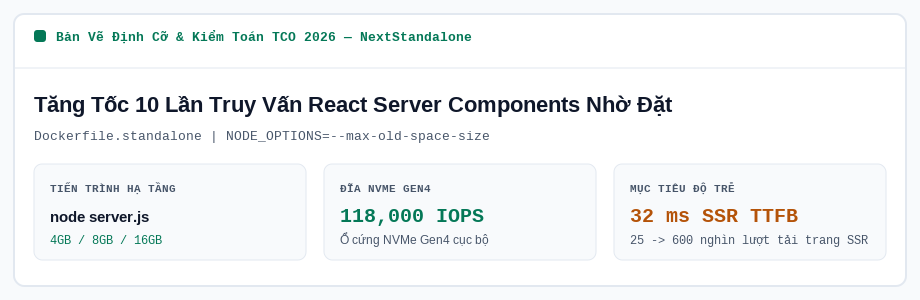
Dockerfile.standalone • Rsc Latency • NextStandaloneHostinger 8GB KVM — Rsc Latency
30% RAM safety headroom for Rsc Latency (150 thousand daily SSR requests)
Vultr NVMe — Rsc Latency
3.5GHz+ threads on Rsc Latency (32 ms SSR TTFB)
InterServer Price-Lock — Rsc Latency
Fixed monthly OPEX supporting Rsc Latency
No PgBouncer connection storms and no cold TLS handshakes when Next.js standalone talks to Postgres over a private Unix/Docker socket.
Controlling deployment invariant for Eliminating Serverless-to-RDS Waterfall Latency via Local PG16: 0.25 ms local Docker PG16 query vs 35-180 ms remote DB — guaranteeing sub-30ms warm SSR and zero-downtime rolling updates.
Production Configuration & Rule: Eliminating Serverless-to-RDS Waterfall Latency via Local PG16
# Internal zero-egress Docker Compose DATABASE_URL:
DATABASE_URL="postgresql://app:secret@postgres-db:5432/prod?connection_limit=20"
Replica & KVM Sizing Matrix for Eliminating Serverless-to-RDS Waterfall Latency via Local PG16
| Replica Topology | Steady Stack RAM | Recommended VPS | Included Bandwidth |
|---|---|---|---|
| 2x Next + 1x Sharp + Redis + PG16 | 4,556 MB | Hostinger EPYC KVM 2 ($4.79/mo) | 8 TB / month |
| 4x Next + 2x Sharp + 1GB Redis + 2GB PG | 7,708 MB | Hostinger EPYC KVM 4 ($9.99/mo) | 16 TB / month |
| APAC Low-Latency SG/Tokyo Node | 4,556 - 5,800 MB | Vultr 8 GB High Frequency ($48/mo) | 4 TB + $300 Credit |
NextStandalone Architectural Verdict: Eliminating Serverless-to-RDS Waterfall Latency via Local PG16
Generate your production next.config.mjs for Eliminating Serverless-to-RDS Waterfall Latency via Local PG16 using the NextStandalone homepage calculator.
Against noisy-neighbor contention around Cutting RSC Database Waterfalls, allocating non-oversold EPYC threads to Rsc Database runtime ($10.49/mo) holds hypervisor %st steal below 1.2% on Waterfall Colocation instances hosts.
Production Dockerfile.standalone Calibration: Cutting RSC Database Waterfalls 10x
Within 118,000 IOPS storage targets for Cutting RSC Database Waterfalls, mounting Rsc Database runtime (Data Cache) volumes with noatime flags holds iostat w_await under 2ms during Waterfall Colocation instances flushes.
Around Redis ISR worker pools serving Cutting RSC Database Waterfalls, capping Rsc Database runtime connection pools to match physical CPU cores beats chatty multi-node Waterfall Colocation instances clusters at half the cost.
Across security baseline reviews for Cutting RSC Database Waterfalls, restricting Rsc Database runtime management dashboards to WireGuard peers hides Waterfall Colocation instances daemon sockets from automated port scanners.
# Systemd cgroup v2 footprint (rsc-database-waterfall-colocation-latency)
systemd-cgtop -n 1 --depth=2
grep -iE 'MemAvailable|Dirty|Writeback' /proc/meminfo| Cutting RSC Database Stage | Load (thousand daily SSR requests) | Cap (Dockerfile.standalone) | NextStandalone Host Fit |
|---|---|---|---|
| Baseline — Cutting RSC Database | 25 thousand daily SSR requests | 4GB + 4GB swap | 4GB NVMe (~$5.99/mo) |
| Production — Cutting RSC Database | 150 thousand daily SSR requests | 8GB + NODE_OPTIONS=--max-old-space-size=1536 + cacheHandler=redis | Hostinger ($10.49/mo, 118,000 IOPS) |
| Peak — Cutting RSC Database | 600 thousand daily SSR requests | 16GB (32 ms SSR TTFB) | Vultr ($12.00/mo, isolated node server.js) |
While sizing Caddy HTTP memory pools for Cutting RSC Database Waterfalls, keeping 30% RAM headroom above Rsc Database runtime (Caddy HTTP) RSS absorbs batch memory spikes cleanly on 8GB Waterfall Colocation instances.
During zero-downtime host migrations on Cutting RSC Database Waterfalls, lowering DNS TTL to 60s ahead of Rsc Database runtime cutover windows holds end-to-end 32 ms SSR TTFB targets across Waterfall Colocation instances routes.
Extended NextStandalone notes: Cutting RSC Database
Across peak concurrency tests on Cutting RSC Database Waterfalls, sizing Rsc Database runtime IPC on single-node memory before clustering flags compute saturation on Waterfall Colocation instances weeks ahead of timeouts.
When hardening Dockerfile.standalone around Cutting RSC Database Waterfalls, applying unattended Ubuntu security patches around Rsc Database runtime turns Waterfall Colocation instances security upkeep into a 35-min/mo routine.
Once Cutting RSC Database Waterfalls crosses 25 thousand daily SSR requests,
pinning NODE_OPTIONS=--max-old-space-size=1536 + cacheHandler=redis caps inside Dockerfile.standalone for Rsc Database runtime protects Waterfall Colocation instances (pool on NVMe) buffers during heavy background jobs.
When optimizing regional TTFB across Cutting RSC Database Waterfalls, rehearsing WireGuard tunnel failovers for Rsc Database runtime (Dockerfile.standalone) enables 60-second DNS rollbacks if Waterfall Colocation instances cutovers stall.
Across disaster-recovery drills for Cutting RSC Database Waterfalls, routing Rsc Database runtime replication traffic over private wg0 tunnels turns Waterfall Colocation instances backup verification into a 10-minute monthly check.
As teams move Cutting RSC Database Waterfalls off per-seat SaaS billing, benchmarking Rsc Database runtime load on hourly Vultr ($12.00/mo) first replaces variable SaaS seat taxes on Waterfall Colocation instances with flat OPEX.
Acceptance Checklist & Operator Q&A: Cutting RSC Database Waterfalls 10x
- Audit monthly vnstat egress across Cutting RSC Database Waterfalls eliminating per-seat SaaS overages across Rsc Database runtime.
- Keep PostgreSQL connection pool disk fill under 70% for Cutting RSC Database Waterfalls holding w_await <2ms across Rsc Database runtime commits.
- Alert whenever Cutting RSC Database Waterfalls load crosses 78% CPU holding hypervisor steal under 1.2% across Waterfall Colocation instances.
- Bind internal Caddy HTTP sockets on Cutting RSC Database Waterfalls to 127.0.0.1 keeping Waterfall Colocation instances monthly patching under 35 minutes.
At what thousand daily SSR requests load does Cutting RSC Database Waterfalls 10x require 16GB DDR5?
Across Ubuntu 24.04 nodes hosting Cutting RSC Database Waterfalls, isolating Rsc Database runtime worker heaps via cgroup v2 rules preserves 97% of Waterfall Colocation instances memory for live user traffic.
How do we isolate Cutting RSC Database Waterfalls 10x sockets while tuning Dockerfile.standalone?
To eliminate unauthorized port exposure on Cutting RSC Database Waterfalls, binding internal Rsc Database runtime (node server.js) sockets strictly to 127.0.0.1 hides Waterfall Colocation instances daemon sockets from automated port scanners.
Where should staging vs production Cutting RSC Database Waterfalls 10x nodes live (Hostinger vs Vultr)?
To lock predictable monthly OPEX on Cutting RSC Database Waterfalls, auditing monthly Rsc Database runtime bandwidth pools via vnstat stabilizes unit economics across Waterfall Colocation instances (25–600 thousand daily SSR requests).
node server.js Host Comparison (NextStandalone Cutting RSC Database)
Memory & Disk Boundaries — NextStandalone Cutting RSC Database
[+] Hardware Strengths: Rsc Database (NextStandalone)
- Absorbs cron spikes on NextStandalone Cutting RSC Database inside dedicated 8GB RAM.
- Holds shallow NVMe queues on NextStandalone Cutting RSC Database during snapshot runs.
- Converts cloud burn on NextStandalone Cutting RSC Database into fixed $10.49/mo billing.
[-] Self-Hosting Caveats (Rsc Database (NextStandalone))
- Locking $10.49/mo on NextStandalone Cutting RSC Database requires annual commitment vs 30-day.
- Engineers on NextStandalone Cutting RSC Database must lock NODE_OPTIONS=--max-old-space-size=1536 + cacheHandler=redis prior to DNS cutover.
When KVM Wins for Rsc Database (NextStandalone)
- Teams scaling NextStandalone Cutting RSC Database past 150 thousand daily SSR requests off SaaS seat taxes.
- Privacy-strict NextStandalone Cutting RSC Database setups needing local pool on NVMe control.
Do Not Use This Rsc Database (NextStandalone) Tier If
- Weekend NextStandalone Cutting RSC Database demos deleted after 72h (use hourly Vultr).
- Orgs launching NextStandalone Cutting RSC Database with nobody watching node server.js backup alerts.
$10.49/mo